
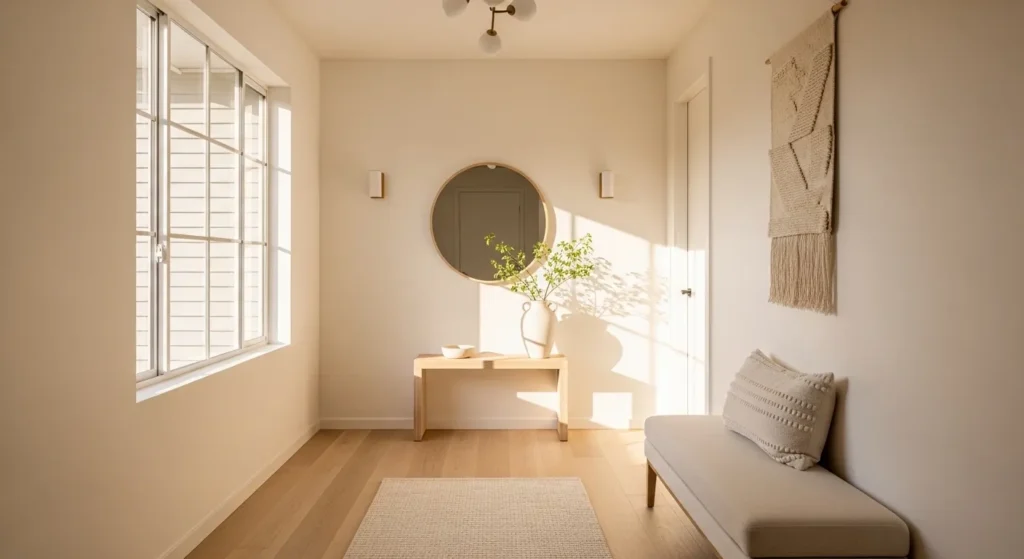
If you’re searching for Japandi Entryway ideas that feel calm the second you walk in, start with an Off-White Entryway foundation. In my own projects, off-white is the “quiet hero” color: it softens light, hides everyday scuffs better than bright white, and gives Japandi decor room to breathe. The magic happens when you layer warm wood, woven textures, and a few intentional shapes—like a round mirror or a low bench—so the space feels welcoming, not staged.
This guide is designed to be practical: you’ll get a palette you can copy, furniture that actually works for daily drop-zone life, and styling moves I use to keep entryways minimal but functional.
Color Palette
Linen Mist#EEE9DE
Oat Beige#D5C4AC
Warm Sandalwood#B79C7D
Soft Pebble#DDDBD5
Honey Oak#B08C60
Mushroom Gray#AFA6A1
Japandi Entryway ideas: Off-White Calm, Warm Wood
The Psychology of Off-White in Your Entryway
An entryway is a “transition zone”—you’re moving from outside noise to inside calm. That’s why I love off-white (specifically creamy, linen-leaning tones like #FAF9F6) for Japandi decor: it visually lowers the volume of a space without feeling cold. Bright white can read sharp and high-contrast, especially against wood. Off-white keeps the mood softer, which is exactly what Japandi Entryway ideas aim for: grounded simplicity with warmth.
In practice, off-white is also forgiving. Real entryways deal with fingerprints, scuffs, and shadowy corners. A slightly warmed off-white diffuses light so corners don’t look gloomy, and it hides minor wear better than a stark gallery white. When you pair it with pale wood and natural fiber textures, your eye reads “clean” and “calm” rather than “empty.”
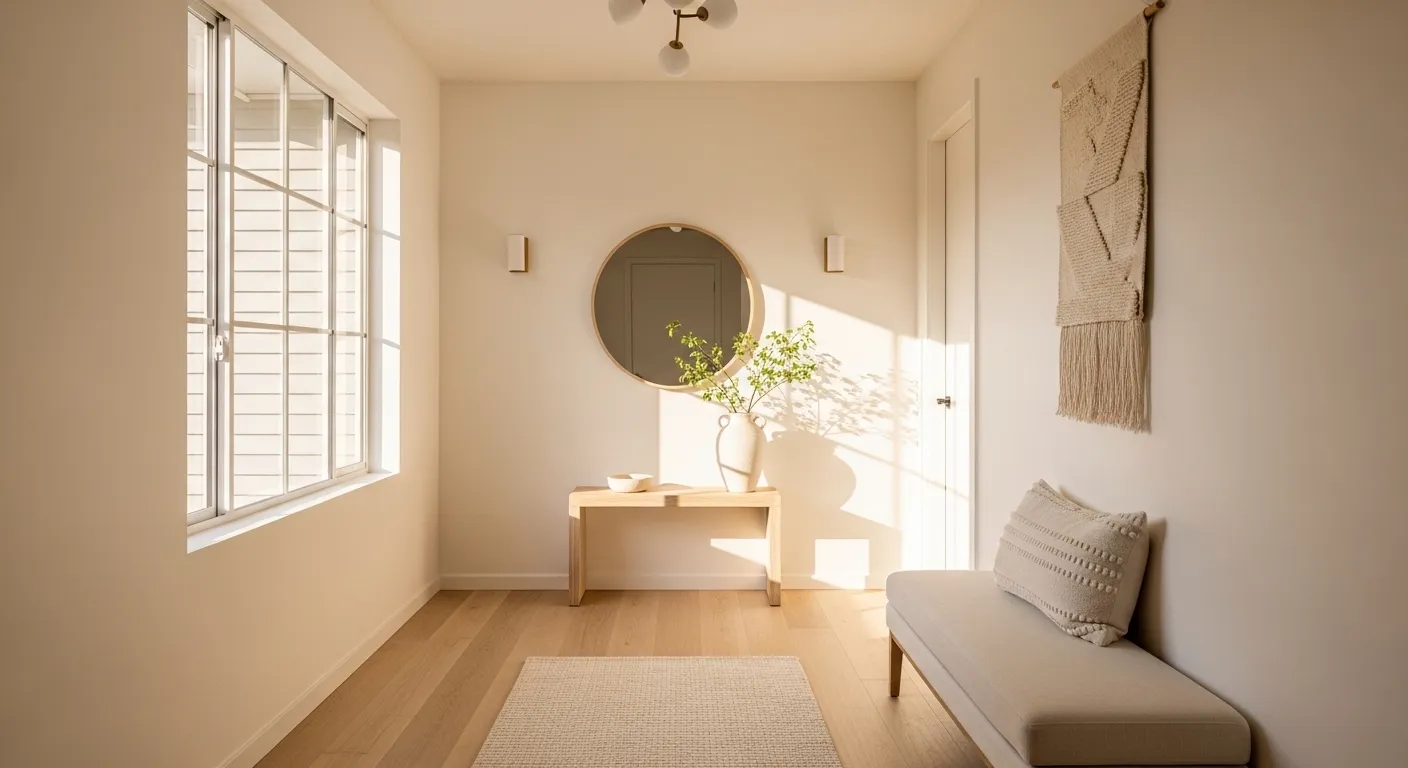
How off-white affects scale, light, and mood
Off-white stretches a narrow foyer because it reflects light without creating harsh glare. If your entry is small, this matters: the space feels airier, and your wood pieces—bench, console, door—become the stars instead of the walls. I often use off-white to “blur” the boundary between trim and wall for a seamless look; then I add one strong shape (a round mirror) to create an intentional focal point.
Choosing the right undertone for Japandi decor
Stick to warm or neutral undertones (linen, oat, soft clay). Cool off-whites can fight the warmth of oak and make your space feel gray. The easiest test: hold a piece of natural oak (or even a bamboo cutting board) against the wall. If the wall reads pinky or icy, switch to a creamier off-white.
Color Combinations & Palette Ideas
The best Japandi Entryway ideas rely on a quiet palette with subtle contrast. Your Off-White Entryway becomes the canvas, but the design comes alive when you add a few disciplined supporting tones: warm oak, mushroom gray, and soft stone. Think in “materials first,” then color: wood (warm), woven fibers (sandy), ceramics (soft gray), and greenery (fresh, not fussy).
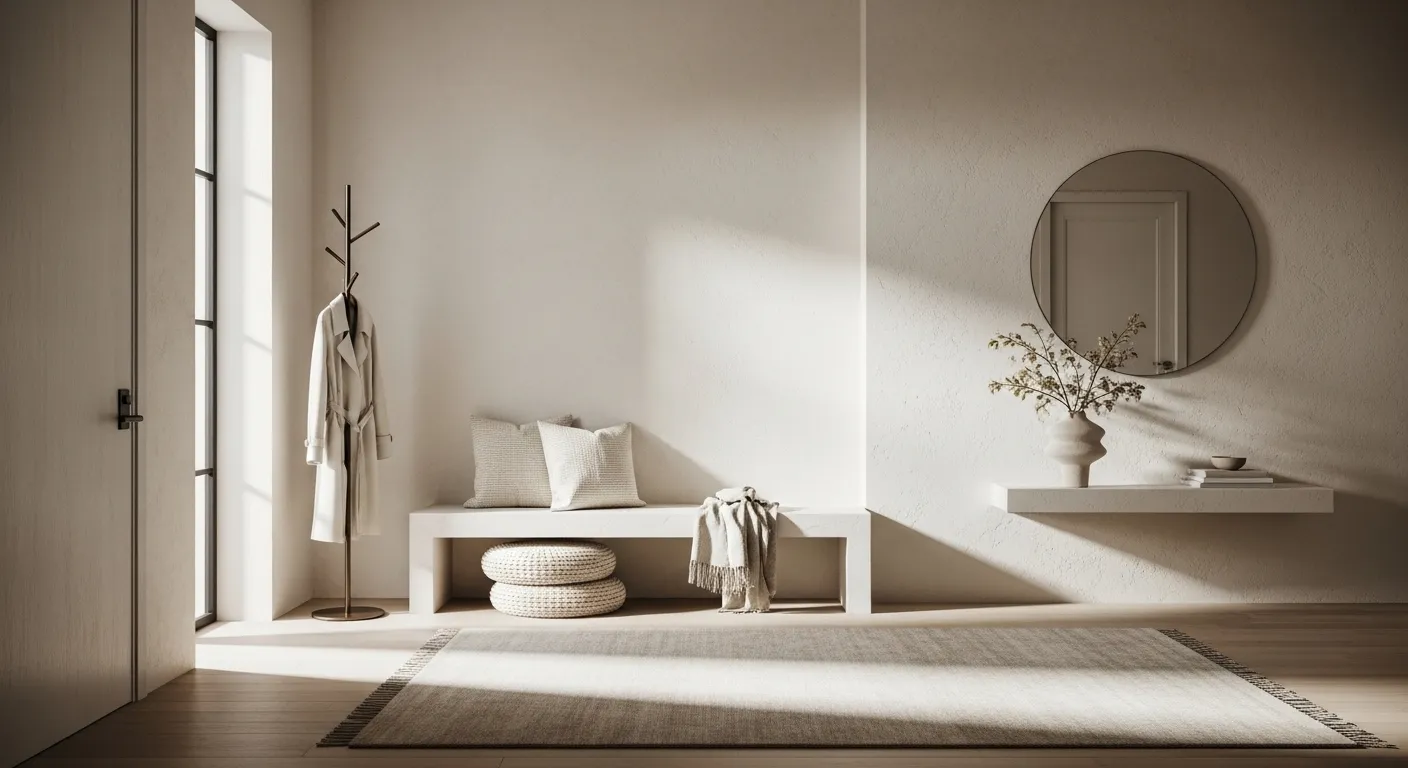
3 easy color formulas that always work
- Off-white + honey oak + black accents (5%): Add a thin black frame mirror or matte black hooks. The key is restraint—black should feel like punctuation, not a headline.
- Off-white + warm beige + mushroom gray: This is the “softest” route. Use mushroom gray in a runner or basket weave to ground the space.
- Off-white + wood + woven texture: If you want fewer colors, increase texture instead—jute, cane, linen, raw ceramic.
Where to place contrast so it feels intentional
I like contrast at hand level and eye level: a darker catchall tray on the console (hand level), and a mirror frame or subtle wall art at eye level. Keep floors and walls lighter so the whole entry reads as open.
Essential Furniture & Decor Elements
When clients ask me for Japandi Entryway ideas, I start with function: where do shoes land, where do keys go, where do bags rest, and how do you sit to put on footwear? Japandi style is minimalist, but it’s not empty—every item earns its place. Your core pieces should be low-profile, warm in tone, and simple in silhouette.
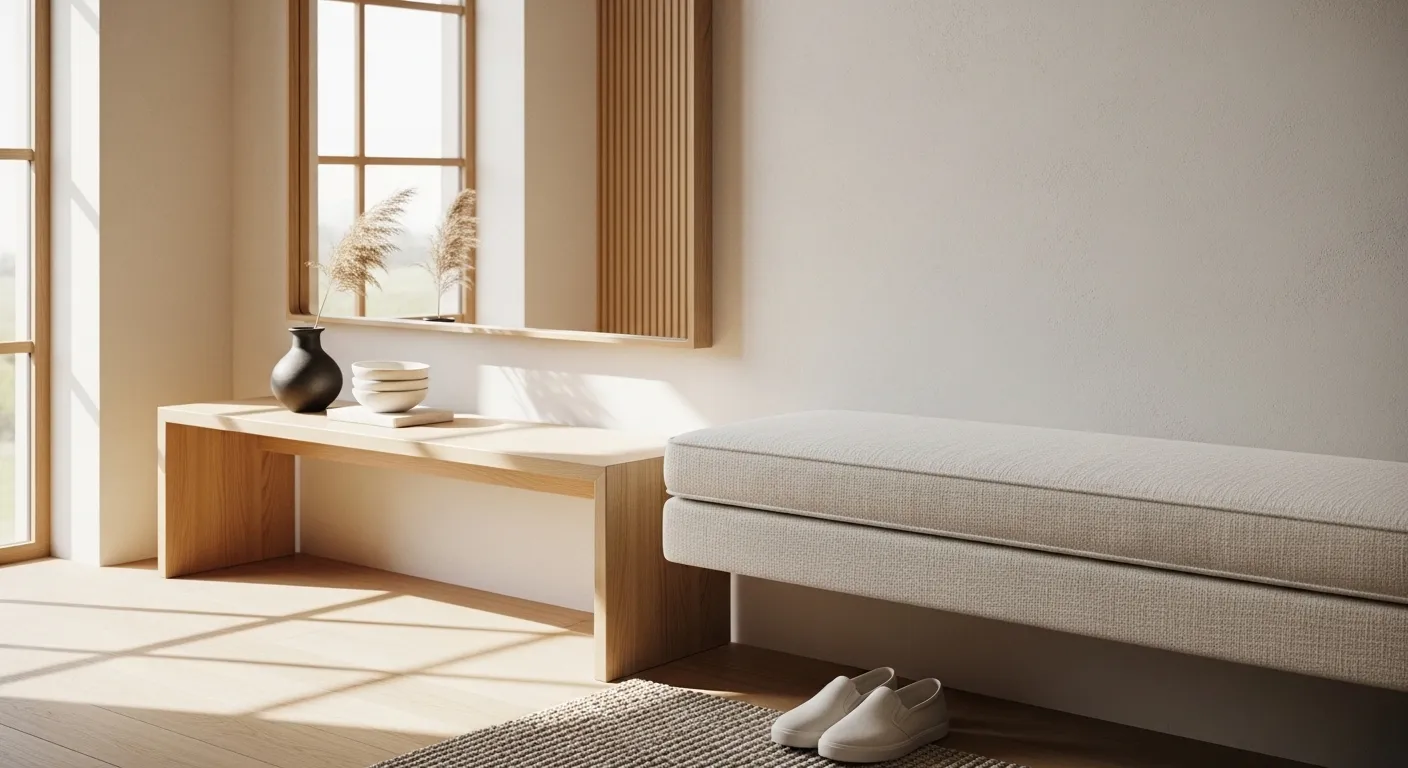
The “must-have 5” for a livable Japandi entry
- A bench (or slim seat): Aim for 36–48 inches wide for most homes. Upholstered is comfortable; wood is visually lighter. Expect $120–$450.
- A console or floating shelf: If space is tight, go floating. Depth around 10–14 inches prevents crowding. Expect $90–$500.
- A mirror: Round mirrors soften all the straight lines of doors and trim. Diameter 28–36 inches works well. Expect $80–$260.
- Closed storage: Woven lidded baskets, a storage bench, or a cabinet keeps visual noise down—crucial for Japandi decor. Expect $40–$220.
- A runner rug: Choose low pile for door clearance. Look for warm neutrals and subtle pattern. Expect $60–$250.
Materials that instantly read “Japandi”
Light oak, ash, bamboo, linen, wool, and matte ceramics are my go-tos. I keep metal finishes minimal—black or brushed nickel, not shiny chrome. In an Off-White Entryway, these materials create depth without needing bold color.
Styling Tips & Budget Ideas
Styling is where an entryway shifts from “basic” to “Japandi.” The trick is to style with negative space—leave breathing room around objects so the calm aesthetic stays intact. I typically limit an entry console to three items: a tray, a small vessel (for stems or branches), and one practical object (like a candle or shoe brush).
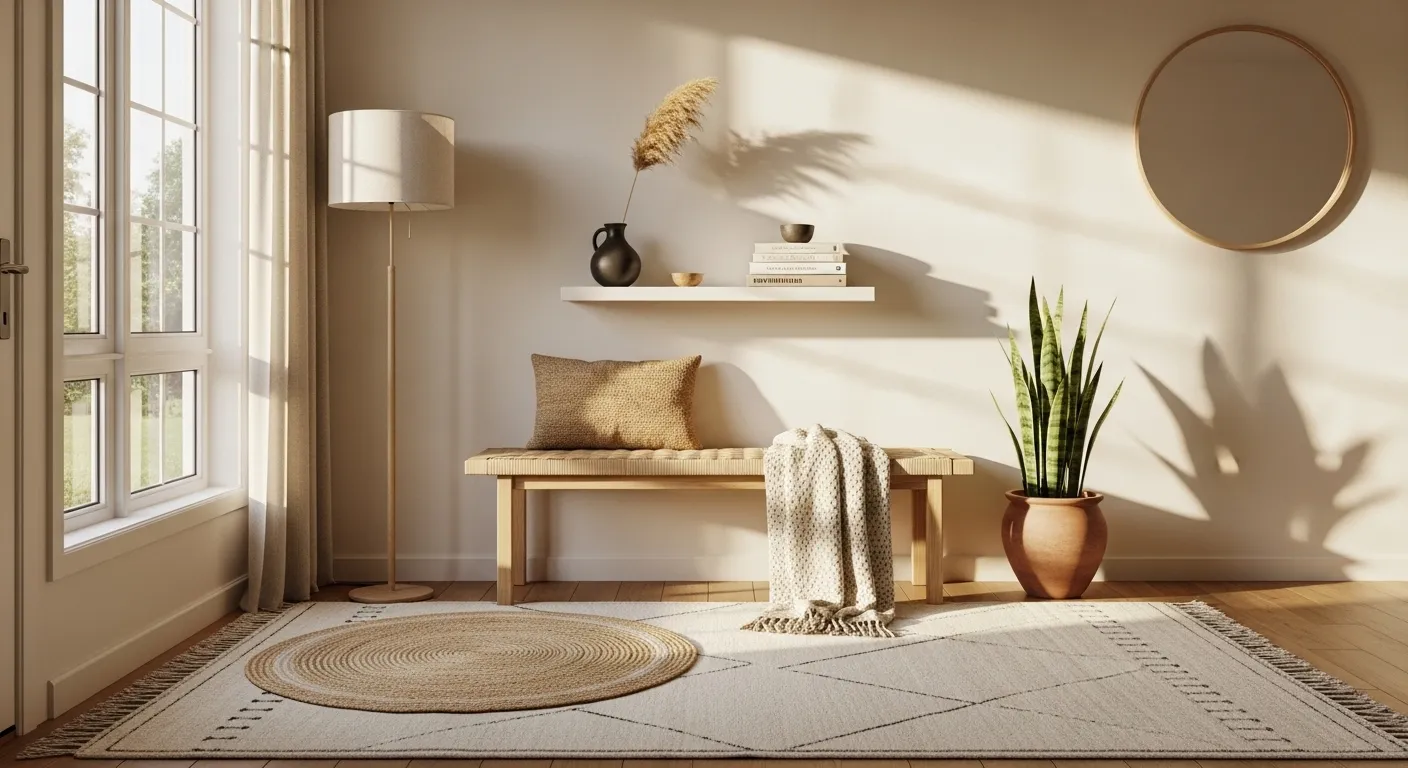
My go-to styling formula (that stays tidy)
- One green element: A snake plant, olive branch stems, or eucalyptus. It adds life without adding clutter.
- One tactile texture: A woven basket, linen cushion, or jute runner.
- One sculptural object: A round mirror, arched vase, or simple wall art.
Keep wall hooks to a clean line (3–5 hooks) and match finishes. If you need more hanging, hide it in a closet or behind a door—Japandi decor works best when the “busy” stuff disappears.
Budget ideas that still look designer
Swap expensive art for woven wall panels or a single oversized matte print. Choose a basic oak-toned mirror frame rather than ornate. And don’t underestimate lighting: a warm LED bulb (2700K) makes off-white walls glow rather than look flat.
How to Recreate This Look
The most successful Japandi Entryway ideas come from building in layers: foundation (color), function (furniture), then restraint (styling). Use the images below as a checklist for proportion—low bench, slim console, round mirror, and a calm runner.
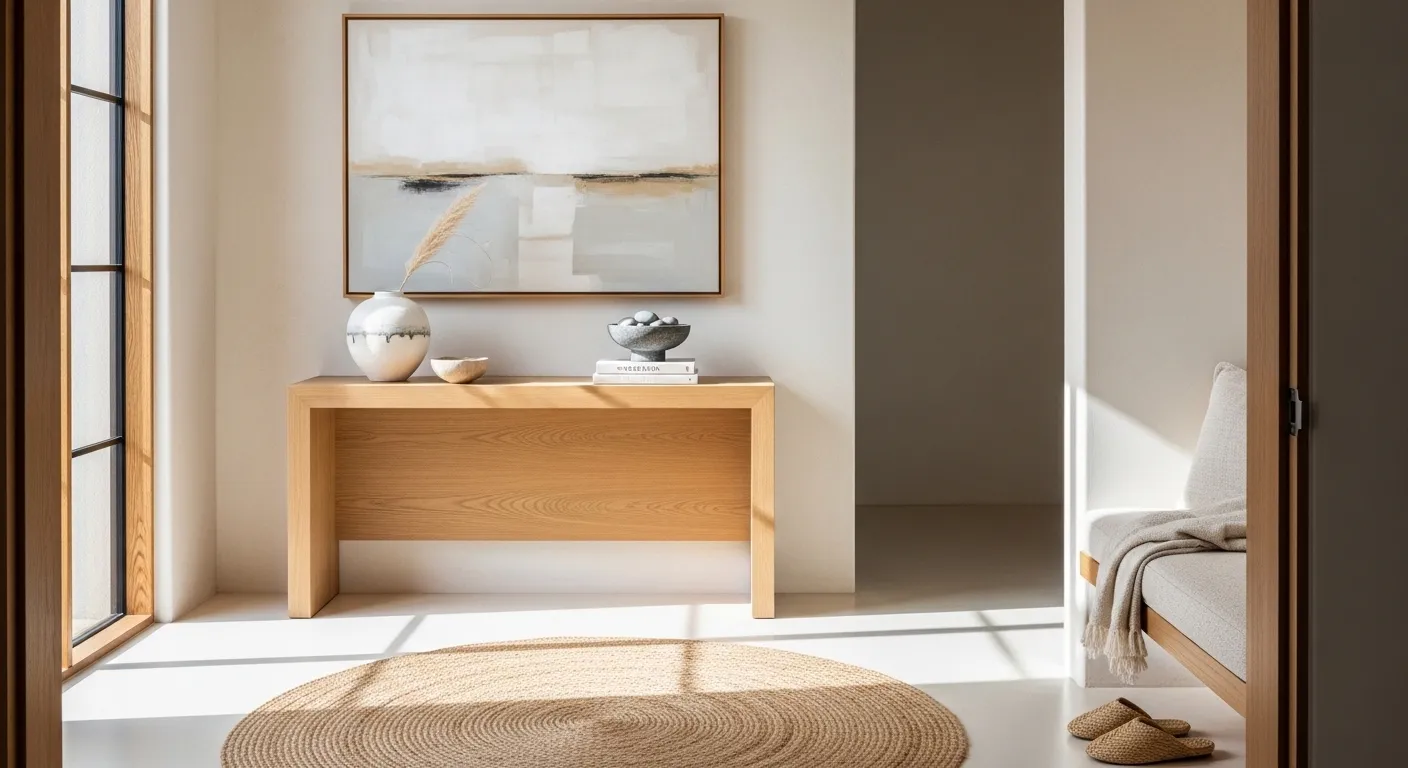
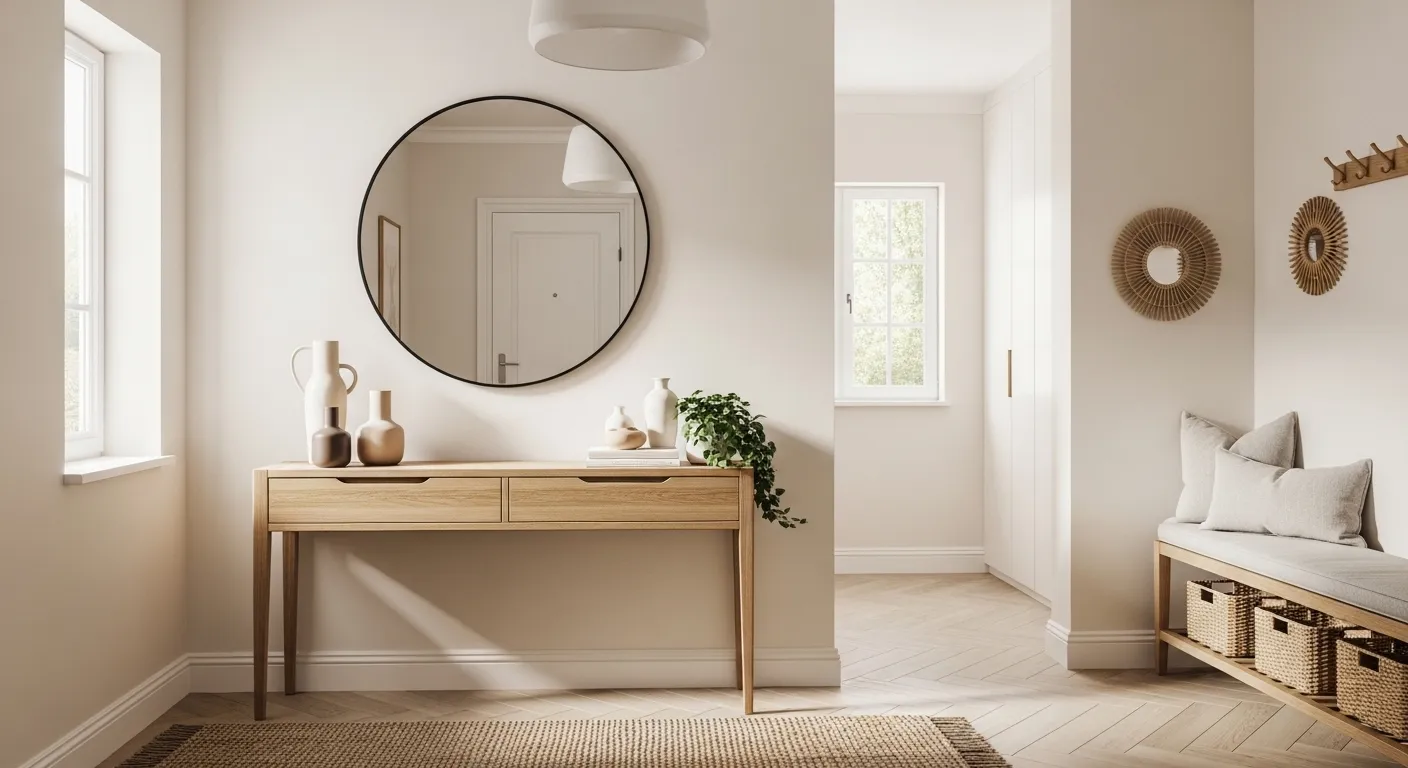
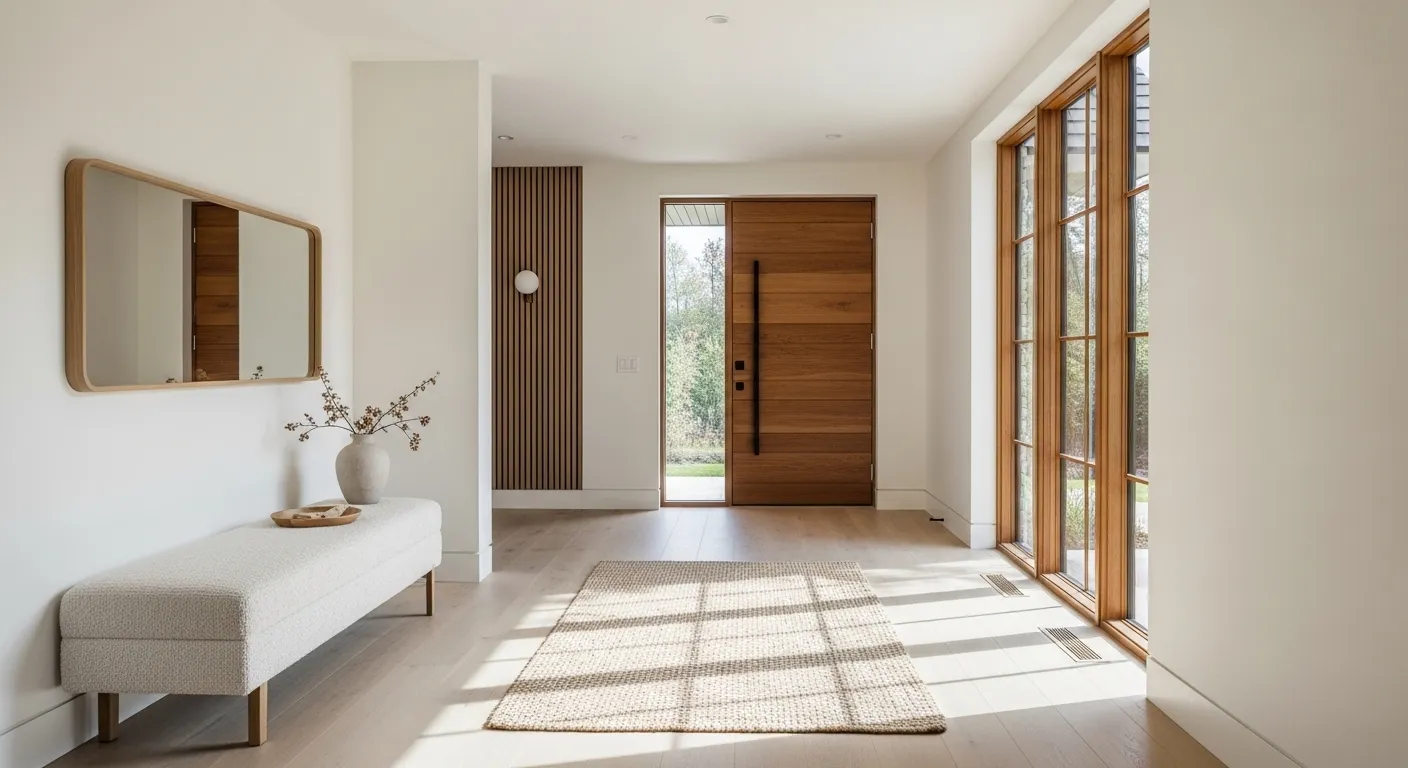
Step-by-step plan
- Paint (or commit to) an off-white base. Choose a warm off-white and keep trim either the same color or one shade lighter to reduce contrast.
- Place a bench first. Center it on the main wall or under the mirror. Leave at least 30″ clearance for the walkway.
- Add a slim console or floating shelf. If you already have a bench, a narrow shelf gives you a landing zone without crowding.
- Hang a round mirror at the right height. I aim for the mirror center about 60″ from the floor, adjusting for household height.
- Build storage that disappears. Use two lidded baskets under the console or a woven storage bench for shoes and seasonal items.
- Finish with one runner + one plant. Keep pattern subtle; choose a low-pile neutral. Add greenery for softness.
Budget
Low Budget: $280–$650
- Warm off-white paint + supplies: $55–$120
- Basic wood bench (or secondhand): $90–$180
- Floating shelf or slim console: $60–$140
- Round mirror: $50–$120
- Runner rug: $25–$90
Mid Budget: $750–$1,450
- Premium paint + prep (spackle, sanding, better roller): $140–$240
- Oak bench (upholstered or storage): $220–$520
- Solid wood console: $250–$550
- Quality round mirror: $130–$260
- Wool or higher-quality runner: $160–$320
FAQ
1) Can a small apartment entry still feel Japandi?
Yes—go vertical. Use a floating shelf, wall hooks in a neat row, and a round mirror. Keep the floor as clear as possible.
2) What if my floors are dark?
Lean into contrast: keep walls off-white, choose a lighter runner, and use lighter oak tones. The dark floor becomes the “grounding” element.
3) How do I keep it from looking boring?
Texture is your friend: woven baskets, a nubby runner, linen cushion, and matte ceramics add depth while staying neutral.
4) What’s the one thing that makes Japandi decor look cluttered?
Too many small items on the console. Consolidate into a single tray and keep the rest behind closed storage.
How to Recreate This Look
- Paint (or commit to) an off-white base. Choose a warm off-white and keep trim either the same color or one shade lighter to reduce contrast.
- Place a bench first. Center it on the main wall or under the mirror. Leave at least 30″ clearance for the walkway.
- Add a slim console or floating shelf. If you already have a bench, a narrow shelf gives you a landing zone without crowding.
- Hang a round mirror at the right height. Aim for the mirror center about 60″ from the floor.
- Build storage that disappears. Use lidded baskets or a woven storage bench for shoes and seasonal items.
- Finish with one runner + one plant. Keep pattern subtle; choose low pile; add a simple green plant.
Budget
Low Budget: $280–$650
- Warm off-white paint + supplies: $55–$120
- Basic wood bench (or secondhand): $90–$180
- Floating shelf or slim console: $60–$140
- Round mirror: $50–$120
- Runner rug: $25–$90
Mid Budget: $750–$1,450
- Premium paint + prep: $140–$240
- Oak bench (upholstered or storage): $220–$520
- Solid wood console: $250–$550
- Quality round mirror: $130–$260
- Wool or higher-quality runner: $160–$320
FAQ
1) Can a small apartment entry still feel Japandi?
Yes—use a floating shelf, a tidy row of hooks, and a round mirror to keep the floor open.
2) What if my floors are dark?
Keep walls off-white, add a lighter runner, and choose lighter wood tones for balance.
3) How do I keep it from looking boring?
Add texture: woven baskets, a nubby runner, linen, and matte ceramics.
4) What makes Japandi decor look cluttered?
Too many small items on the console—edit down to one tray and closed storage.
Final Thoughts
The most livable Japandi Entryway ideas aren’t about perfection—they’re about calm function. Start with an Off-White Entryway base, bring in warm wood and woven texture, and keep your surfaces edited so the space feels like a reset button when you walk in. With the right bench, a simple round mirror, and a few disciplined Japandi decor choices, your entryway can stay serene even on the busiest weekdays.