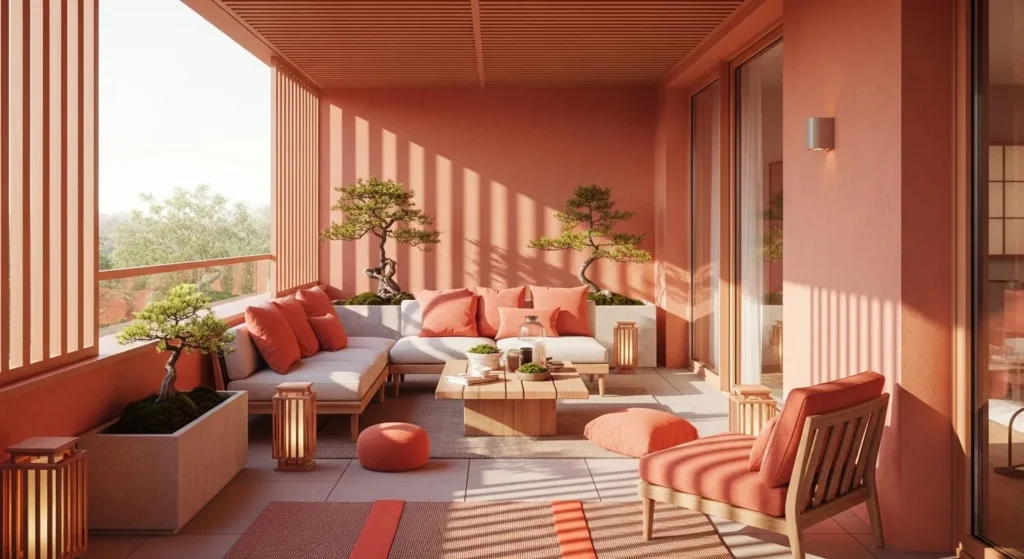

If you love calm, minimalist spaces but still want your balcony to feel welcoming (not stark), these Japandi Outdoor Balcony ideas built around a soft coral tone are an easy win. Coral brings warmth and “human” energy to Japandi decor, while wood, stone, and greenery keep it grounded. I use this formula constantly on real balconies: one comforting color, low-profile seating, and a few deliberate textures—then you edit ruthlessly so the space feels restful every day.
Color Palette
Soft Coral Clay#D17B68
Warm Oat#E9D8C6
Cocoa Terra#9E513F
Baked Sienna#B86454
Blush Terracotta#D38D79
Misted Greige#DAD4D0
Japandi Outdoor Balcony ideas: Coral Calm for Everyday Living
The Psychology of Coral in Your Outdoor Balcony
Coral is one of my favorite “bridge” colors for a balcony because it sits between pink and orange—warm, flattering, and energizing without feeling loud. In a Japandi setting, coral acts like a gentle hearth: it makes pale wood feel richer, it softens concrete and metal railings, and it keeps minimal layouts from turning cold. If you’re aiming for a Coral Outdoor Balcony that still reads calm, the secret is to treat coral as a comfort accent, not a full-saturation takeover.
On outdoor spaces, coral is also practical: it looks good in morning sun, late afternoon light, and even under warm string lights at night. That’s why I often use coral on cushions, small planters, or a single wall—then I layer in quiet neutrals (oat, greige) so your eye can rest.
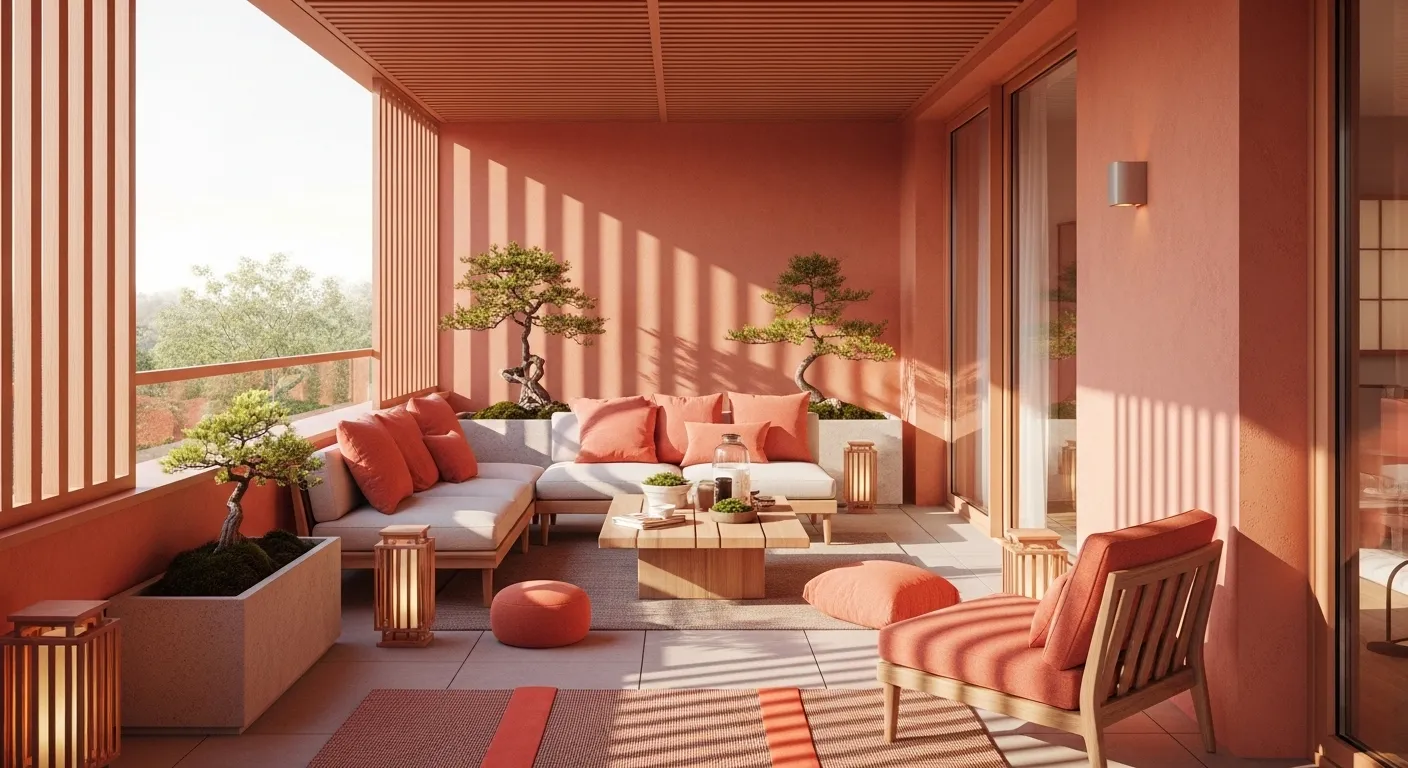
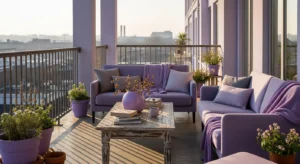
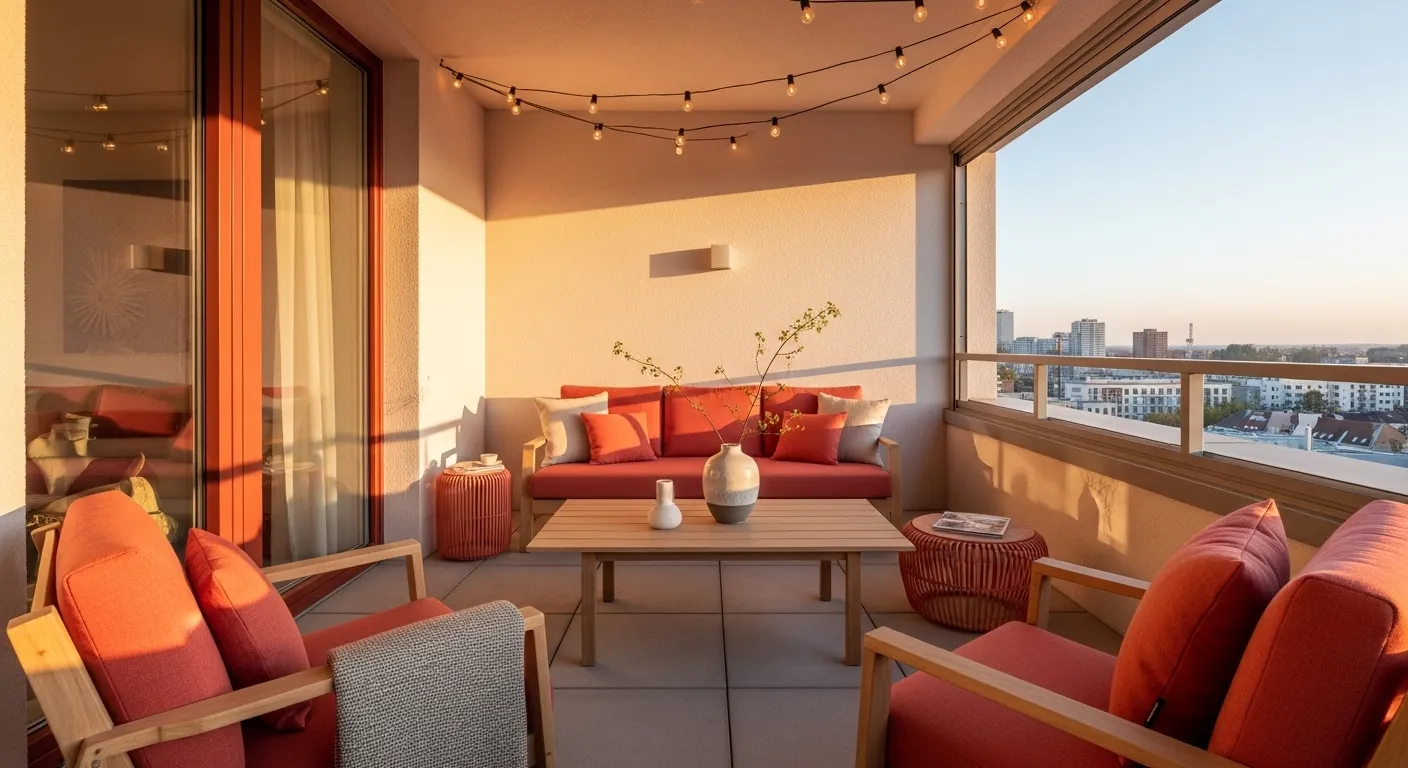
In the wide shot above, coral works because it’s balanced by three Japandi anchors: low seating (visual calm), light wood (warmth without heaviness), and greenery (life). When clients tell me they want “cozy but minimal,” this is exactly the emotional target: grounded, soft, and tidy.
How coral changes the feel of a small balcony
Small balconies can feel exposed. Coral psychologically “brings the walls in,” making the space feel more intimate—especially when you repeat it in two or three spots (for example: two cushions + one small ceramic piece). This repetition is a classic Japandi decor move: controlled, intentional, never cluttered.
Color Combinations & Palette Ideas
The best Japandi Outdoor Balcony ideas are built on contrast that stays quiet: warm vs. cool, smooth vs. textured, light vs. grounded. With coral as your warm accent, I typically design the rest of the palette like this: one main neutral (oat/greige), one wood tone (ash, oak, or teak), and one “ink” color for definition (charcoal, dark bronze, or espresso). That’s enough to create depth without visual noise.
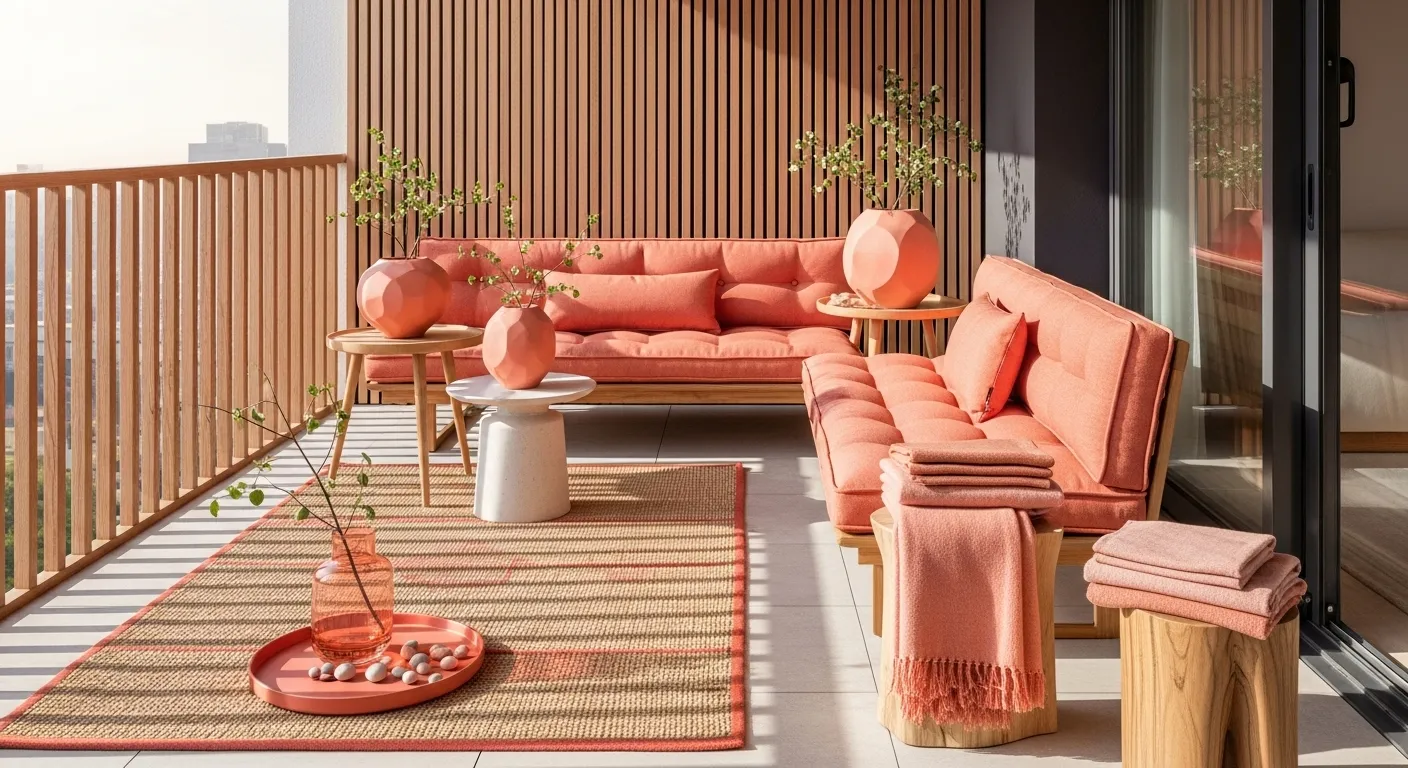
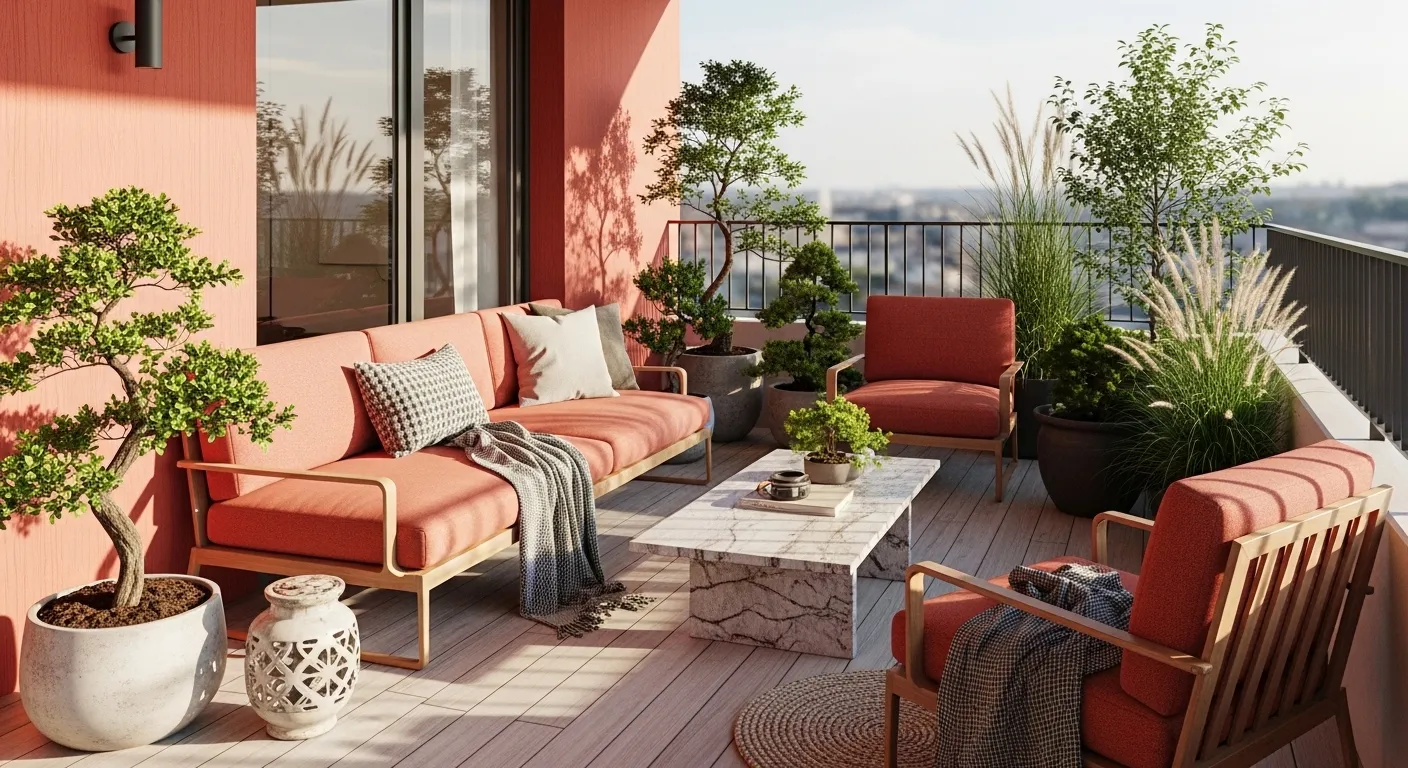
Notice how the coral cushions in the vignette read “fresh” rather than “sweet.” That’s because the surrounding materials are mature: slatted wood, a woven rug, and airy neutrals. If you want coral to feel sophisticated, pair it with matte textures and natural fibers.
3 easy coral pairings that still feel Japandi
- Coral + oat + pale wood: the safest combo for rentals and small spaces; it makes everything feel brighter.
- Coral + greige + charcoal accents: adds structure; perfect if you have black window frames or metal railings.
- Coral + clay browns + deep green plants: richer and moodier; great for balconies with lots of foliage.
Material notes (so the colors look expensive)
For a refined Coral Outdoor Balcony, choose coral in textiles (woven, bouclé-like outdoor fabric) rather than glossy plastic accessories. Keep metals brushed (not shiny), and use stone or stone-look surfaces to balance the warmth—this is where Japandi decor really earns its “premium” feel.
Essential Furniture & Decor Elements
Furniture is where most balconies go wrong: pieces are either too bulky or too flimsy. The Japandi approach is simple—low, clean-lined, and comfortable. Start with seating you’ll actually use for 20–40 minutes at a time, then add one surface for a drink, a book, or a small tray. From there, you layer in texture and a few sculptural decor items, but you keep the footprint light so circulation stays easy.
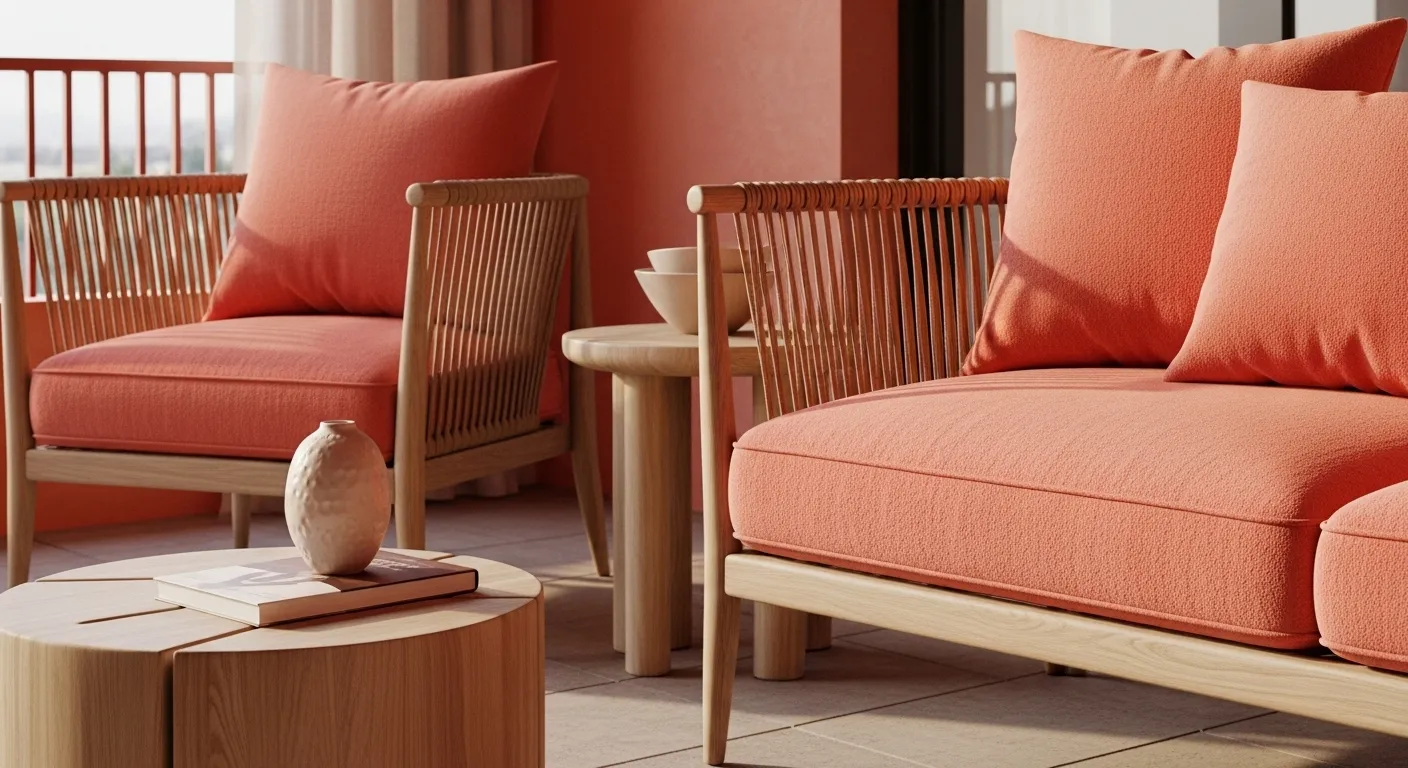
This detail shot is a perfect template: light wood lounge chairs (warm, timeless), coral cushions (soft focus color), and a minimalist table (function without clutter). If you’re collecting pieces over time, prioritize them in this order:
Balcony basics (buy these first)
- Low-profile lounge seating: two chairs or a compact loveseat. Look for 24–30″ seat height with supportive back angles.
- Outdoor cushions in coral: use removable covers so you can wash or swap seasonally.
- One small table: round or softly rectangular; 18–24″ wide is plenty for most balconies.
- Outdoor rug: flatweave or polypropylene; it instantly makes the zone feel like a “room.”
Japandi decor layers (choose 2–4, not all)
- Planters with structure: bonsai-style, column planters, or built-ins—anything that feels intentional.
- Lanterns or warm lighting: battery lanterns are easier than hardwiring and fit the Japandi mood.
- Ceramic accents: one matte vase or tea-light holder in a sandy neutral adds craft without clutter.
Styling Tips & Budget Ideas
Styling a Japandi balcony is less about adding and more about editing. I style from the ground up: rug first, then furniture placement, then lighting, then plants, then one “quiet focal point” (a tray, a lantern cluster, or a single sculptural pot). The goal is a clean view from inside your home—because you’ll see the balcony every day through the glass.
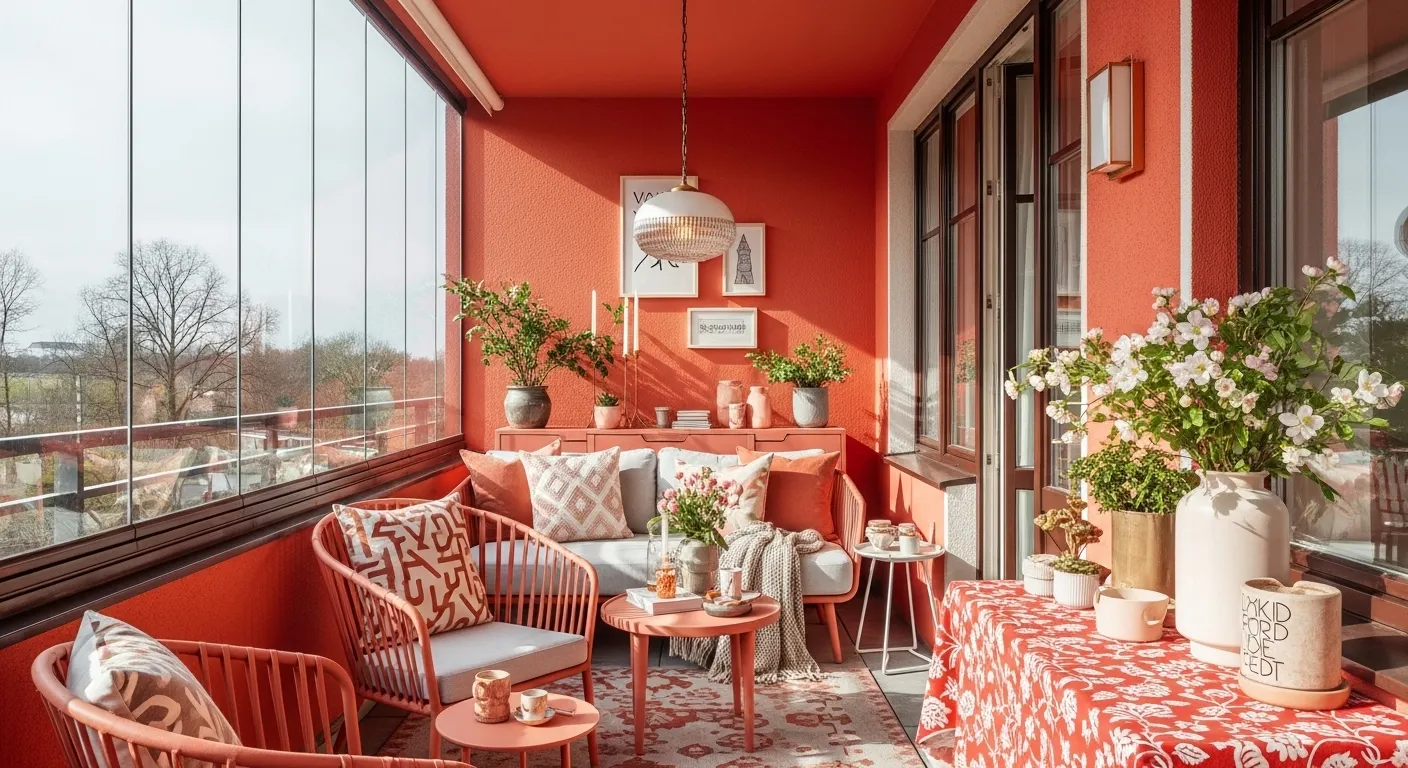
My go-to layout rules (that work on most balconies)
- Float seating slightly off the railing: even 4–6 inches helps it feel like a room, not a perch.
- Create one clear walkway: aim for 24″ of pass-through so the space feels calm, not cramped.
- Cluster accessories: a tray with one lantern + one small vase looks intentional; scattered items look messy.
- Use plants as “soft walls”: tall planters at corners add privacy without blocking light.
For a Coral Outdoor Balcony, I like to repeat coral at two heights: seat level (cushions) and eye level (one small wall art tile, a lantern with coral glass, or a coral-toned ceramic). That repetition feels designed, not accidental.
How to Recreate This Look
If you want a balcony that looks like a designed outdoor lounge (not a storage corner), follow this sequence. It’s the fastest way I’ve found to build Japandi Outdoor Balcony ideas that feel cohesive, especially when coral is the star accent.
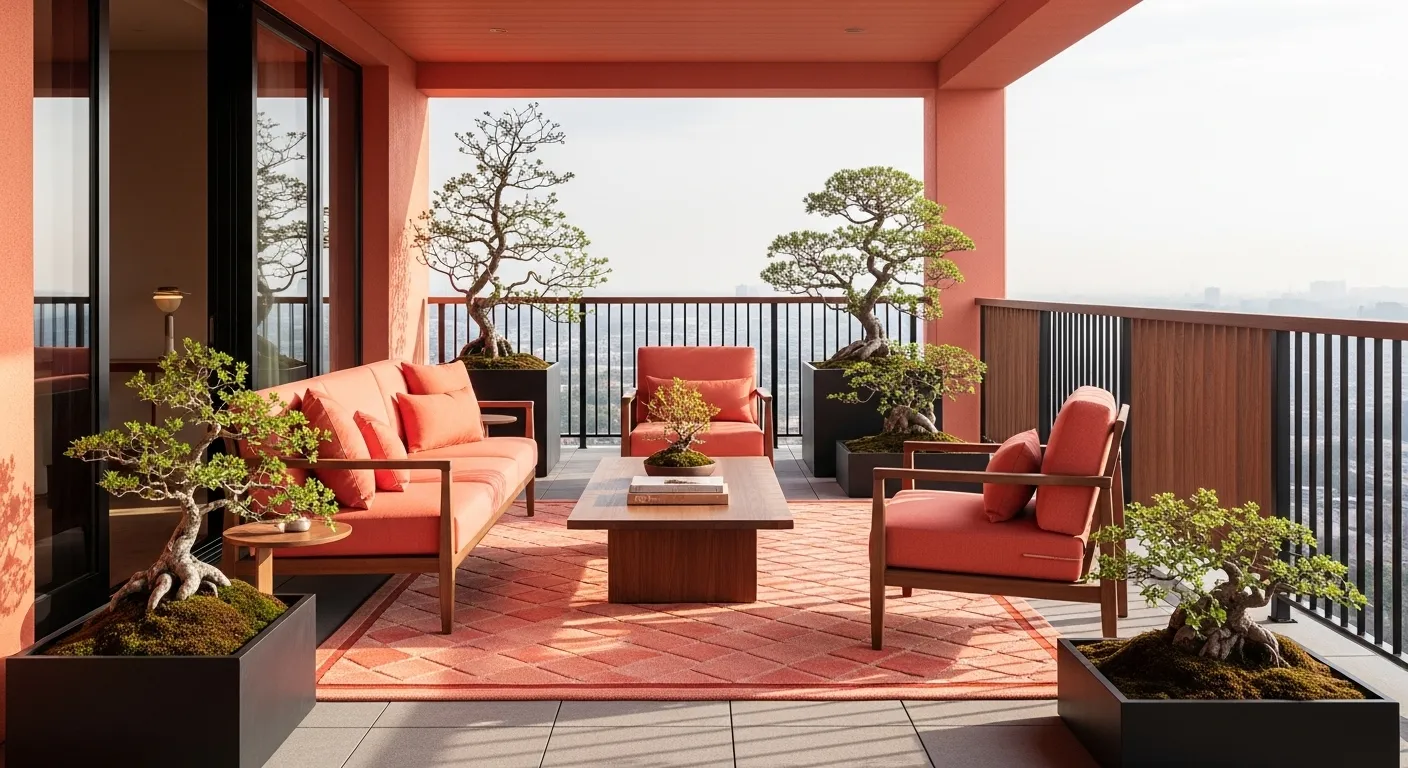
Step-by-step plan (do it in this order)
- Measure and map the “usable zone”: mark door swing + walkway first. This prevents buying furniture that blocks traffic.
- Choose one seating hero: a compact loveseat or two lounge chairs. Keep lines simple and legs light so the balcony feels airy.
- Add coral comfort: two cushions + one lumbar in coral tones is usually enough. This is where Japandi decor meets warmth.
- Ground it with a rug: pick a flatweave neutral; it visually expands the balcony and makes seating feel anchored.
- Bring in greenery strategically: two “mass” plants (taller) and one “detail” plant (bonsai or small sculptural pot).
- Finish with soft light: lanterns or string lights on a dim, warm setting (around 2200–2700K).
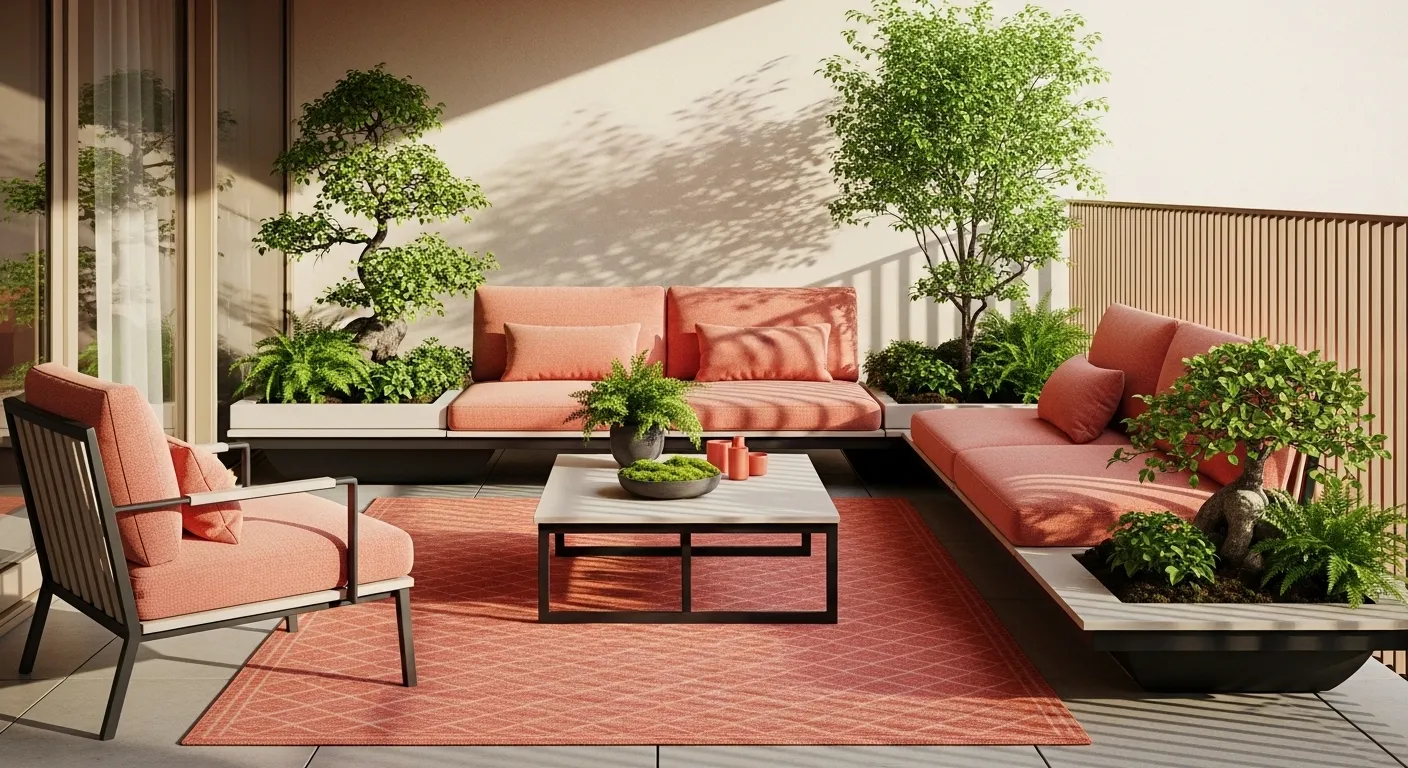
Budget (2 tiers only)
Low Budget: $280–$650
- 2 floor cushions or compact bistro chairs + pads: $90–$220
- Outdoor rug (4′ x 6′ or 5′ x 7′): $45–$120
- Small side table (metal or acacia): $35–$90
- Coral cushion covers (set of 2–4): $30–$80
- Lanterns or string lights: $25–$70
- Planters + starter plants: $55–$150
Mid Budget: $900–$1,850
- Teak/acacia loveseat or 2 lounge chairs: $450–$1,050
- Outdoor cushions in coral (weather-resistant inserts): $120–$280
- Low coffee table (wood or stone-look): $120–$350
- Outdoor rug (better weave/texture): $120–$260
- Planters (ceramic/cement) + fuller plants: $140–$420
- Warm lighting (lantern set + rechargeable bulbs): $60–$190
FAQ
1) Will coral feel too bright for Japandi?
Not if you keep it to accents and pair it with oat/greige neutrals and natural wood. Coral becomes warmth—not noise—when the rest of the palette is quiet.
2) What’s the easiest way to start if my balcony is tiny?
Choose one compact chair, one small table, and two coral cushions. Add a slim planter at the corner for a “soft wall,” and stop there.
3) How do I keep outdoor cushions looking fresh?
Use UV-resistant fabric, store cushions in a bench or deck box during storms, and choose removable covers so you can wash them monthly.
4) What plants suit a Japandi balcony?
Go for structured greens: boxwood-style shrubs, olive or citrus (if sun allows), snake plant, dwarf bamboo (contained), or a bonsai-style focal plant.
How to Recreate
- Measure your balcony and confirm a 24″ walkway.
- Pick low-profile seating in light wood tones.
- Add coral cushions (2–4 pieces max) to keep Japandi decor clean.
- Anchor with a neutral flatweave outdoor rug.
- Layer greenery: 2 larger planters + 1 sculptural “detail” plant.
- Finish with warm lighting (2200–2700K) using lanterns or string lights.
Budget
Low Budget: $280–$650 (chairs/cushions $90–$220, rug $45–$120, table $35–$90, coral covers $30–$80, lighting $25–$70, planters/plants $55–$150)
Mid Budget: $900–$1,850 (loveseat/chairs $450–$1,050, cushions $120–$280, coffee table $120–$350, rug $120–$260, planters/plants $140–$420, lighting $60–$190)
FAQ
Will coral feel too bright? Keep it to 10–20% of the visual field and pair with oat/greige + wood.
Best first purchase? Comfortable low seating—everything else supports it.
How to prevent fading? Choose UV-resistant textiles and store cushions during storms.
Which plants fit Japandi? Structured greenery like bonsai-style focal plants, olive/citrus (sun), snake plant, or contained bamboo.
Final Thoughts
The most successful Japandi Outdoor Balcony ideas don’t rely on lots of decor—they rely on restraint, comfort, and a palette that feels human. Coral is a beautiful way to add warmth to Japandi decor without losing that calm, minimalist clarity. Keep coral in a few repeat accents, choose low-profile wood furniture, and let greenery and soft lighting do the rest. With that formula, your Coral Outdoor Balcony becomes a daily retreat you’ll actually use—morning coffee, sunset wind-down, and everything in between.