
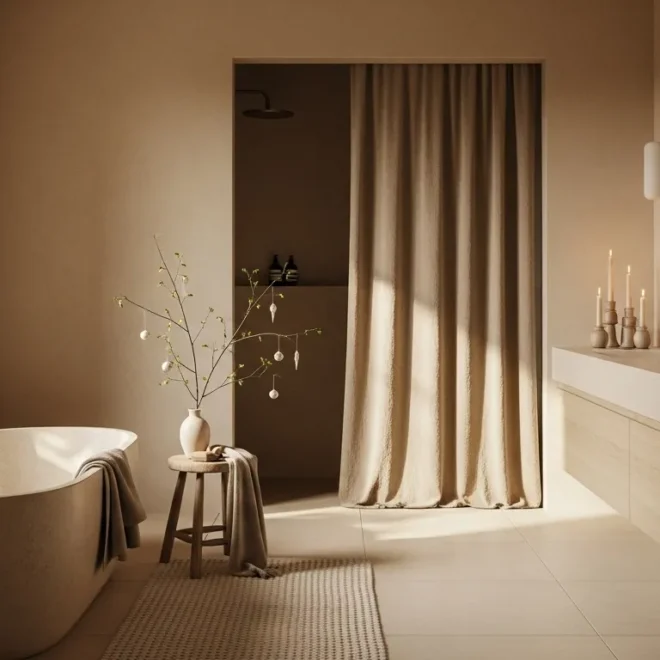

If your bathroom feels busy, chilly, or visually cluttered, a beige-forward Japandi refresh can change everything. In this guide, I’m sharing my favorite Japandi Bathroom ideas for a calm, spa-like space—grounded in warm neutrals, natural wood, and the “less but better” mindset that makes Japandi decor so livable. We’ll keep it holiday-ready for Christmas without adding mess: think subtle greenery, soft candlelight, and tactile textiles that feel intentional rather than seasonal overload.
As a designer, I use beige when clients want serenity but don’t want their bathroom to read “all white and sterile.” A well-layered Beige Bathroom has depth—especially when you pair it with pale oak, stone textures, and a few matte-black accents for definition.
Color Palette
Japandi Bathroom ideas: The Psychology of Beige (and Why It Works)
Beige as a “quiet luxury” foundation
Beige gets mislabeled as boring when it’s used as a single flat paint color with no supporting textures. In Japandi decor, beige is a foundation, not the whole story. It’s what lets wood grain, stone veining, linen curtains, and matte ceramics become the “pattern.” In bathrooms—where we already have a lot of hard, reflective surfaces—beige softens bounce light and makes the space feel warmer instantly.
From a practical standpoint, beige is forgiving. Water spots on white tile and fingerprints on glossy black cabinetry can feel constant; a layered beige palette hides day-to-day life a bit better while still looking elevated.
How beige affects the mood (especially in winter)
During Christmas season, bathrooms can feel extra cold: tile floors, bare walls, and the harshness of overhead lighting. Beige shifts the mood toward “cocooning.” I like to explain it to clients as creating a visual temperature—beige reads warmer than white, and it makes candlelight and soft sconces look intentional instead of dim.
Design cues to copy from a serene beige Japandi bathroom
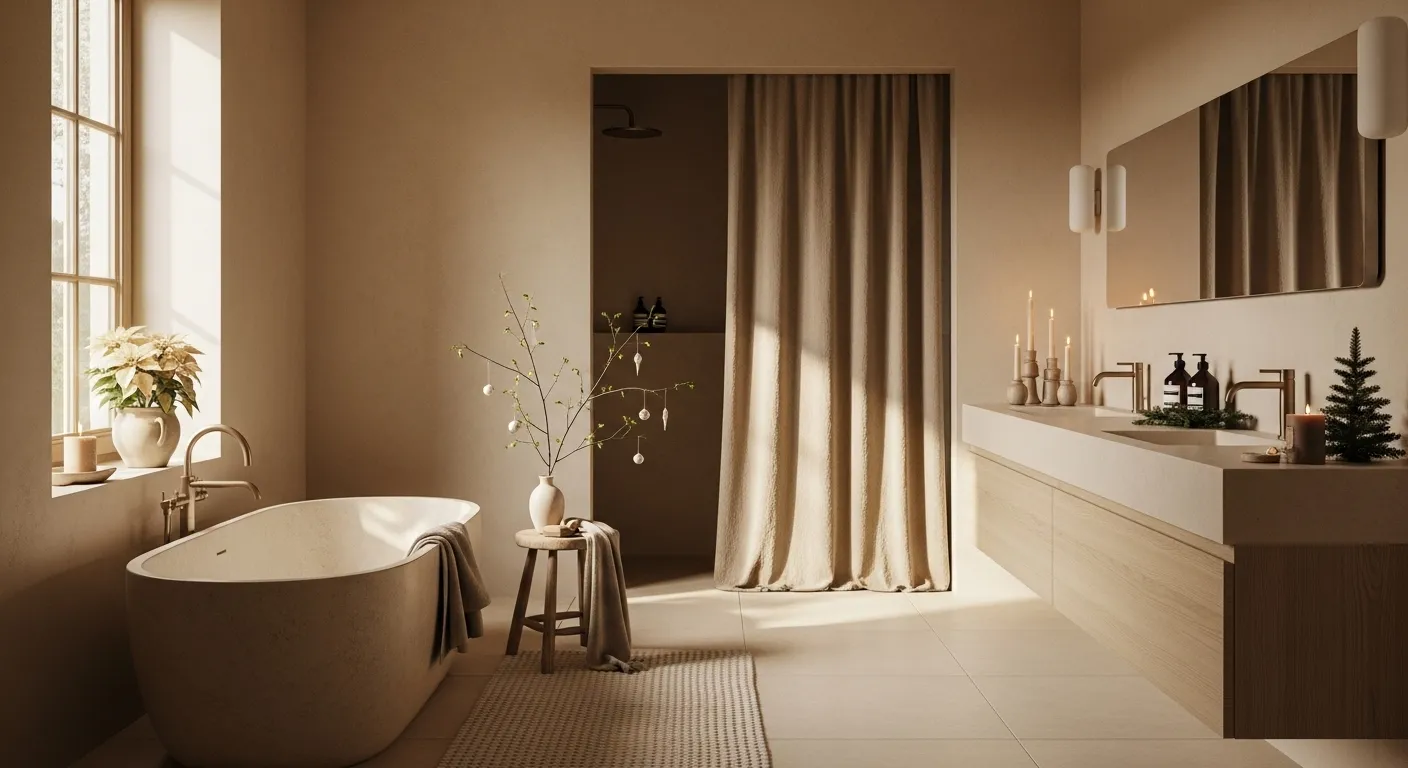
Notice how the calm, wide-shot spaces that feel truly spa-like usually do three things: they keep the biggest surfaces light (walls/tile), they anchor the middle zone with wood, and they add a thin line of contrast (often black or dark bronze) to define the shapes. The image below is a great example of beige dominance done right—soft, bright, and still grounded by wood.
Color Combinations & Palette for a Christmas-Ready Beige Bathroom
The core formula: light beige + pale wood + soft black
My reliable Japandi palette formula for bathrooms is simple: start with a light beige base (tile or paint), add pale wood (oak, ash, or bamboo), then use a small amount of black for definition (faucets, mirror frame, or a slim sconce). This keeps the space modern and clean without drifting into farmhouse or traditional.
For Christmas season, I avoid “red and green” as literal colors in a Japandi bathroom. Instead, I bring in evergreen through natural stems, and the “red” becomes warmth—cognac wood, clay, or a cinnamon-toned candle.
Holiday accents that still feel Japandi
To keep it aligned with Japandi decor, think: one small bundle of eucalyptus, one sculptural vessel, one scent element (cedar, hinoki, or pine), and one textile upgrade (waffle towel or linen hand towel). If you add glittery décor, novelty signage, or bright candy-cane stripes, the calm breaks immediately.
Three easy beige pairings (choose one)
- Oat + Oak + Matte Black: crisp, contemporary, and the easiest to maintain.
- Sand + Walnut + Dark Bronze: warmer and more boutique-hotel.
- Ivory Beige + Light Ash + Charcoal: best for small bathrooms that need brightness.
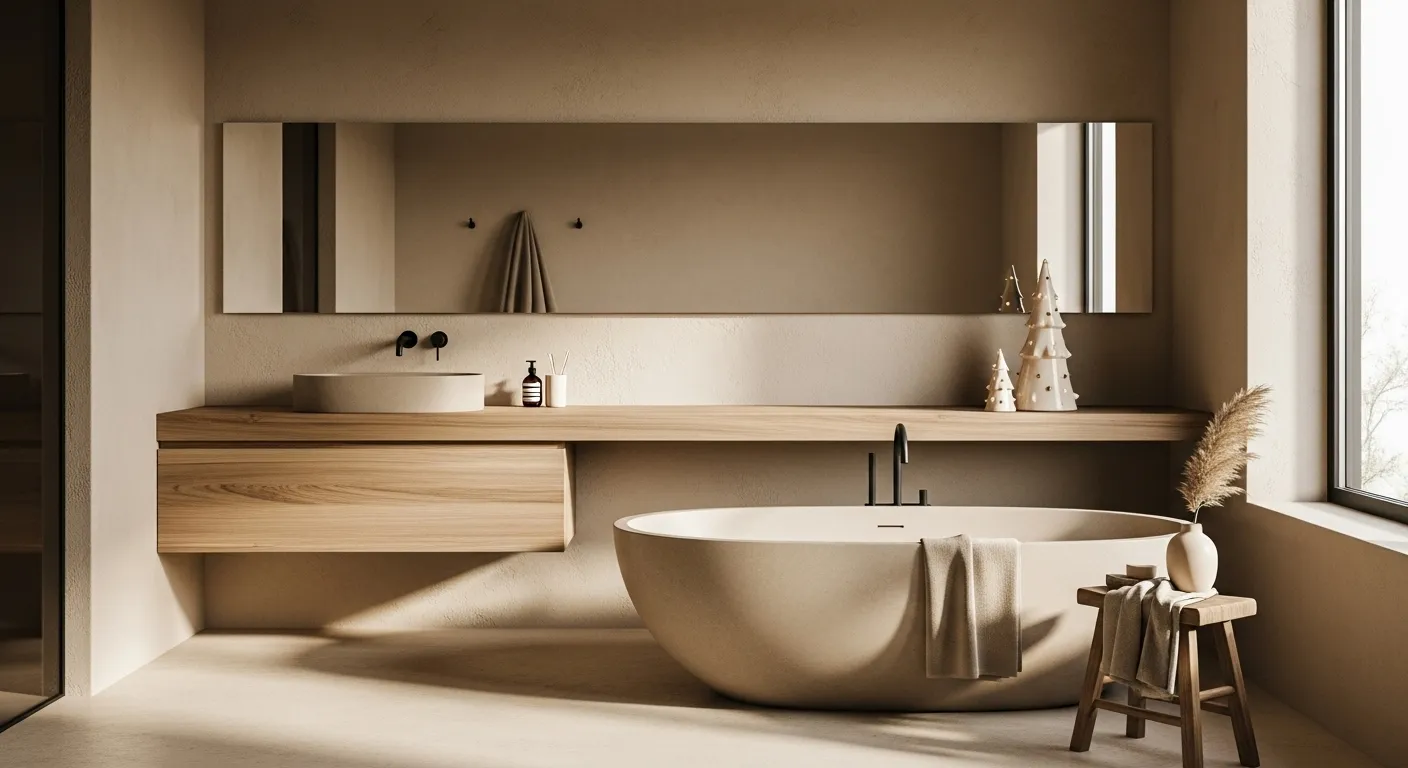
The vignette below shows how beige can hold multiple tones—tile, wood, and creamy ceramics—without looking monochrome. This is the sweet spot for a Beige Bathroom that feels intentional.
Essential Furniture & Decor for Japandi Function (Without Clutter)
Vanity choices: floating, grounded, or double
If you want the most “Japandi” look quickly, start with the vanity. I typically recommend:
- Floating vanity: visually lighter, makes small bathrooms feel bigger, and is easiest to clean under.
- Grounded vanity with recessed toe-kick: still clean-lined but feels more substantial for larger rooms.
- Double vanity: great for shared bathrooms; keep the countertop calm by planning storage from day one.
Wood tones should lean natural and matte—avoid orange stain or heavy gloss. Hardware should be minimal or integrated. The goal is to make the vanity read like a simple piece of furniture rather than a cabinet wall.
Material mix: concrete, oak, and matte black details
In Japandi bathrooms, the “interest” comes from mixing tactile materials: concrete, microcement, stone, limewash, oak, and linen. A concrete sink or counter can look elevated, but it needs warmth nearby—typically oak drawers or a wood mirror frame—to keep the room from feeling cold.
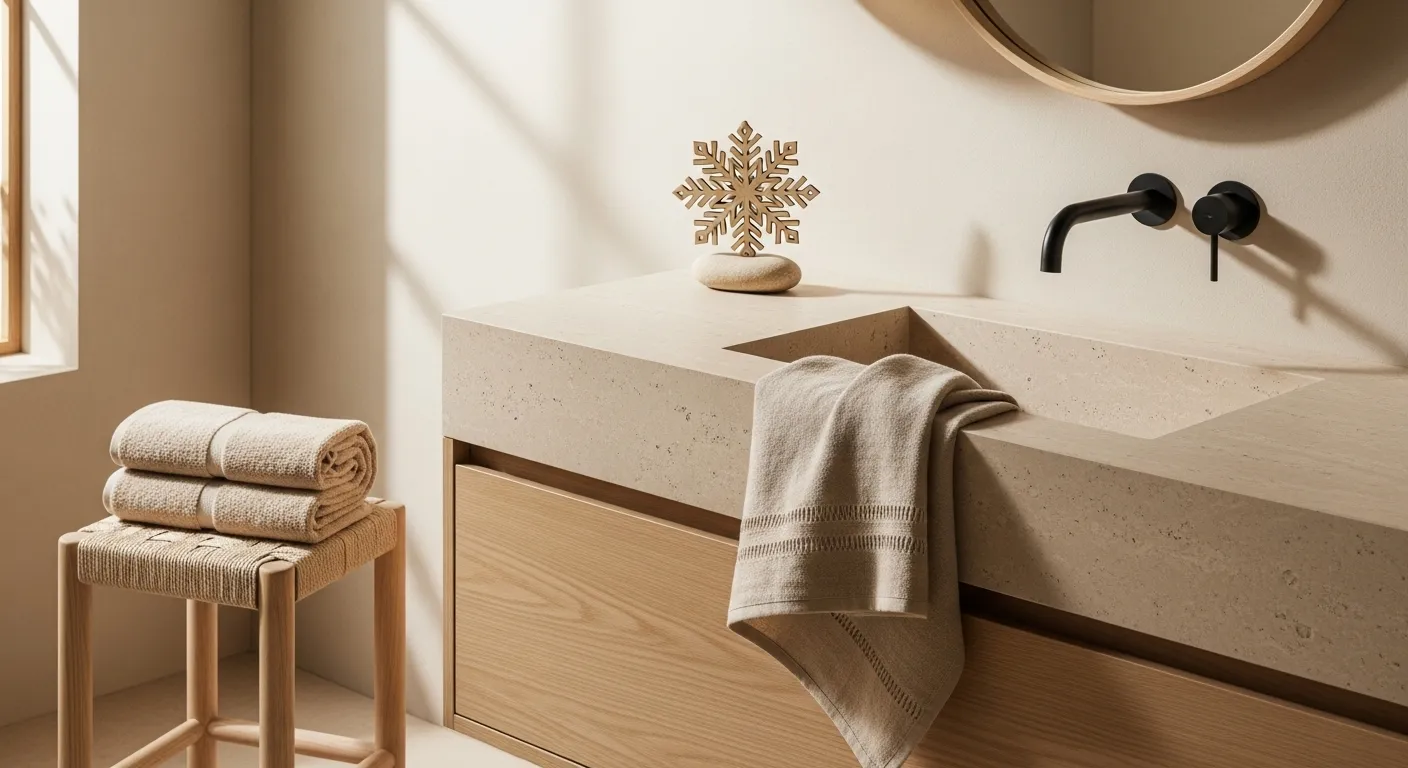
The detail shot below is a perfect example of that balance: concrete for quiet modernity, oak for warmth, and a matte black faucet for crisp contrast.
Decor rules I use to keep it serene
Bathrooms collect clutter fast, so I use three rules with clients:
- One “object” per surface: one tray, one vessel, one candle—no more.
- Everything else must be functional: soap, hand towel, tissue, storage jar.
- Repeat materials: if your faucet is matte black, repeat black once more (mirror frame or a slim hook) to make it feel intentional.
Light, Texture & Layout: The Spa Feel Comes From These Details
Lighting layers (the fastest upgrade)
Most bathrooms rely on a single ceiling light, which is why they can feel harsh. To create a spa atmosphere, layer your lighting:
- Task: flattering light at the mirror (sconces or a backlit mirror).
- Ambient: a soft ceiling fixture on a dimmer.
- Accent: candlelight or a small, hidden LED strip under a floating vanity (great at night).
For Christmas season, dimmers matter even more—soft evening light makes the space feel cozy and festive without adding a single decoration.
Texture stacking: how to make beige look expensive
The trick is to stack at least four textures so the beige palette has depth:
- Hard matte: porcelain tile, microcement, or plaster.
- Soft matte: painted walls, limewash, or clay paint.
- Natural grain: oak vanity, wood stool, or teak bath mat.
- Textile: linen curtain, waffle towels, or a ribbed bath rug.
When clients tell me “beige looks flat,” it’s almost always because they only used paint and shiny tile—no textiles, no grain, no matte stone.
Layout cues that make a bathroom feel like a retreat
Even if you can’t change plumbing, you can improve the feeling of space:
- Create one clear focal line: mirror centered on vanity, sconce symmetry, towel hook aligned.
- Keep negative space: leave some wall empty; that “breathing room” is Japandi.
- Use a single large mirror: instead of multiple small pieces that fragment the wall.
Japandi Bathroom ideas for Christmas: Styling Tips & Budget-Friendly Upgrades
Festive, not fussy: a simple holiday styling recipe
Here’s my go-to Christmas styling recipe for a Japandi bathroom:
- Greenery: one small bundle of cedar/eucalyptus in a ceramic vase (or a single stem in a bud vase).
- Warm scent: hinoki, pine, or sandalwood candle (or essential oil diffuser).
- Textile swap: fresh beige/cream towels and a waffle bath mat for texture.
- One natural accent: a small wood stool or stone tray to corral essentials.
That’s it. The room stays calm—and it photographs beautifully.
Budget-friendly upgrades with real impact
If you want visible change without renovating, these are the upgrades I recommend most often:
- Swap the faucet: matte black or brushed nickel ($120–$380).
- Upgrade the mirror: round, thin frame ($140–$420).
- Replace the towel bars/hooks: matching set ($35–$160).
- Add a linen-look shower curtain: ($35–$110) and hang it higher to make the room feel taller.
- Change bulbs: 2700K–3000K warm white, high CRI ($18–$60 total).
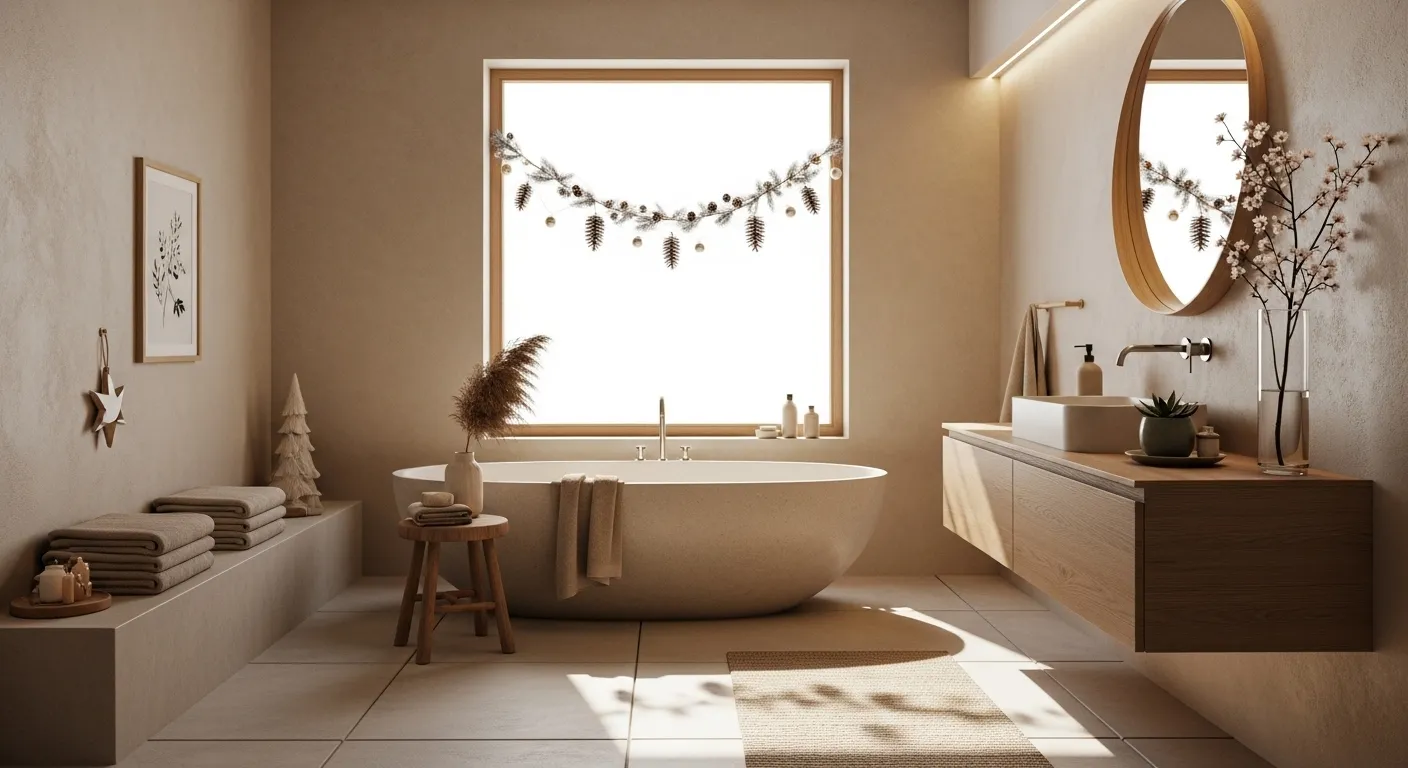
The cozy corner below captures what we’re aiming for: soft light, rounded shapes, warm wood, and calm beige layers—easy to recreate without overdecorating.
What to remove (the underrated step)
Japandi bathrooms feel expensive because they’re edited. Before you buy anything, remove:
- extra bottles from the tub ledge (decant into matching pump bottles if needed)
- non-matching plastic organizers
- visual noise on countertops (store backups elsewhere)
This “subtraction step” is a real design move—and it’s free.
How to Recreate This Japandi Look
Step-by-step plan (in the right order)
- Set your beige base: Choose a warm beige paint or tile direction (avoid cool gray-beige). If repainting, plan $45–$110 for paint and supplies; if re-tiling a small shower wall, plan $650–$2,200 materials depending on tile.
- Choose one wood tone and commit: Light oak reads most Japandi. Aim for matte finish and simple fronts. A vanity swap typically runs $650–$2,800 depending on size and countertop.
- Add a “thin line” of contrast: Pick matte black (or dark bronze) for the faucet, mirror frame, and one accessory. Keeping it consistent is what makes it look designed.
- Fix the lighting: Add warm bulbs, then consider sconces or a backlit mirror. Budget $18–$60 for bulbs, $160–$650 per sconce installed.
- Layer texture: Linen or linen-look shower curtain, waffle towels, and a wood/stone tray. Expect $120–$360 for a full textile refresh.
- Style for Christmas minimally: One greenery moment, one candle/diffuser, and one sculptural object—then stop.
- Edit daily items: Use matching pump bottles and one lidded container for small items. Budget $25–$85.
Visual reference to keep proportions right
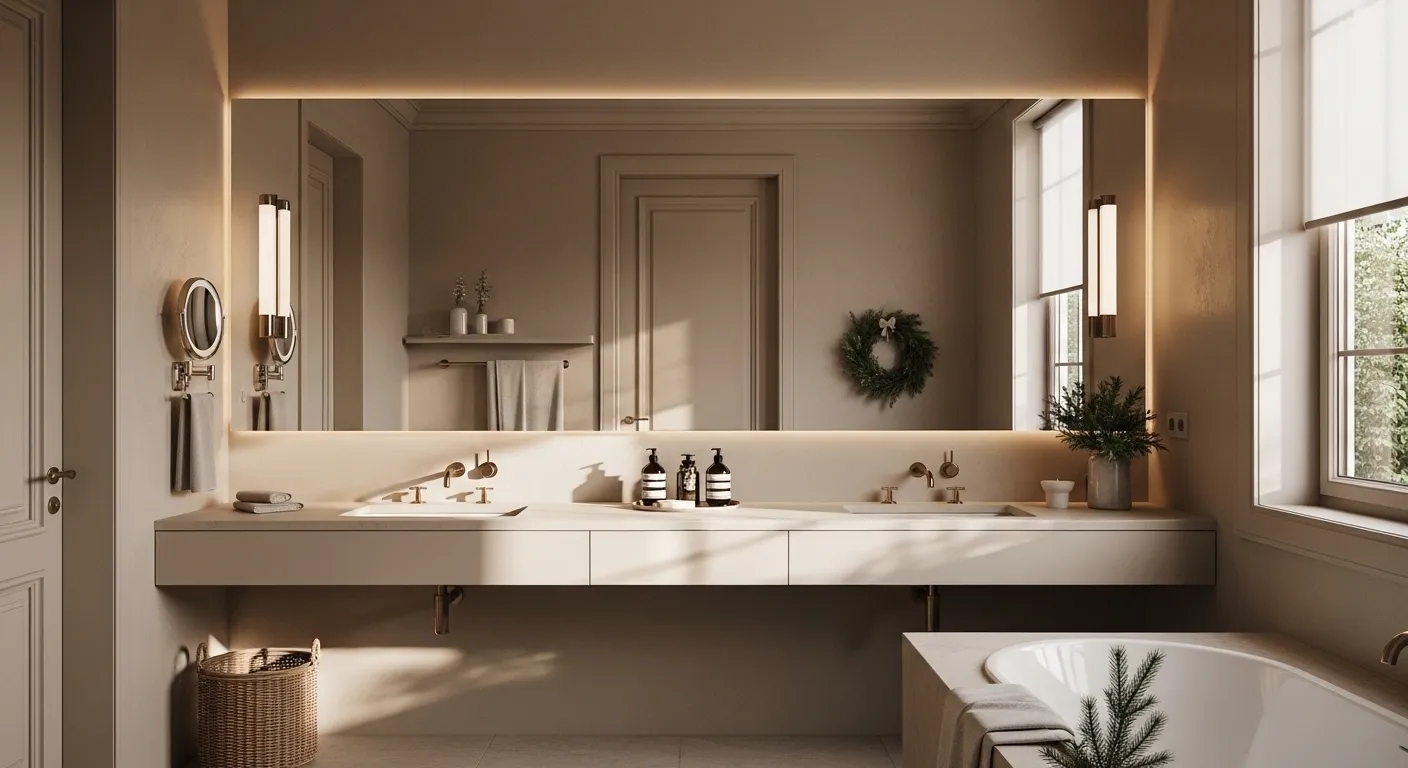
When you’re recreating a Japandi space, proportion matters as much as color: a floating vanity keeps the room light, the tub shape stays simple, and lighting is soft and symmetrical. Use the image below as a guide for balance—note how little is on display, and how the warm beige tones still feel crisp.
Common mistakes to avoid
- Going too monochrome: beige needs texture and at least one contrast element.
- Too many wood tones: mixing oak, walnut, and bamboo randomly reads messy fast.
- Holiday overload: one evergreen moment is enough—keep the rest spa-simple.
Budget Breakdown
Low budget: $250–$900 (refresh, no construction)
- Warm beige paint + supplies: $60–$140
- Round mirror: $140–$280
- Faucet swap (if DIY-capable): $120–$260
- Textiles (waffle towels, bath mat): $70–$220
- Accessories (tray, soap pump, canister): $35–$120
Who this is best for: renters (with removable updates), guest baths, or anyone who wants the Japandi mood quickly.
Mid budget: $2,500–$7,500 (the “it feels new” level)
- Floating vanity + top: $900–$3,200
- Plumber install: $450–$1,200
- Mirror + sconces + electrician: $650–$2,200
- Flooring upgrade (LVP suitable for baths or porcelain tile): $500–$1,800
- Paint + trim refresh: $200–$600
Who this is best for: primary bathrooms that need better storage and lighting without moving plumbing lines.
High budget: $12,000–$35,000+ (renovation + spa details)
- Tile (shower + floors) materials & labor: $6,000–$18,000
- Freestanding tub + filler: $2,200–$7,500
- Custom vanity + stone top: $3,500–$10,000
- Glass shower enclosure: $1,200–$3,800
- Heated floor upgrade: $900–$2,600
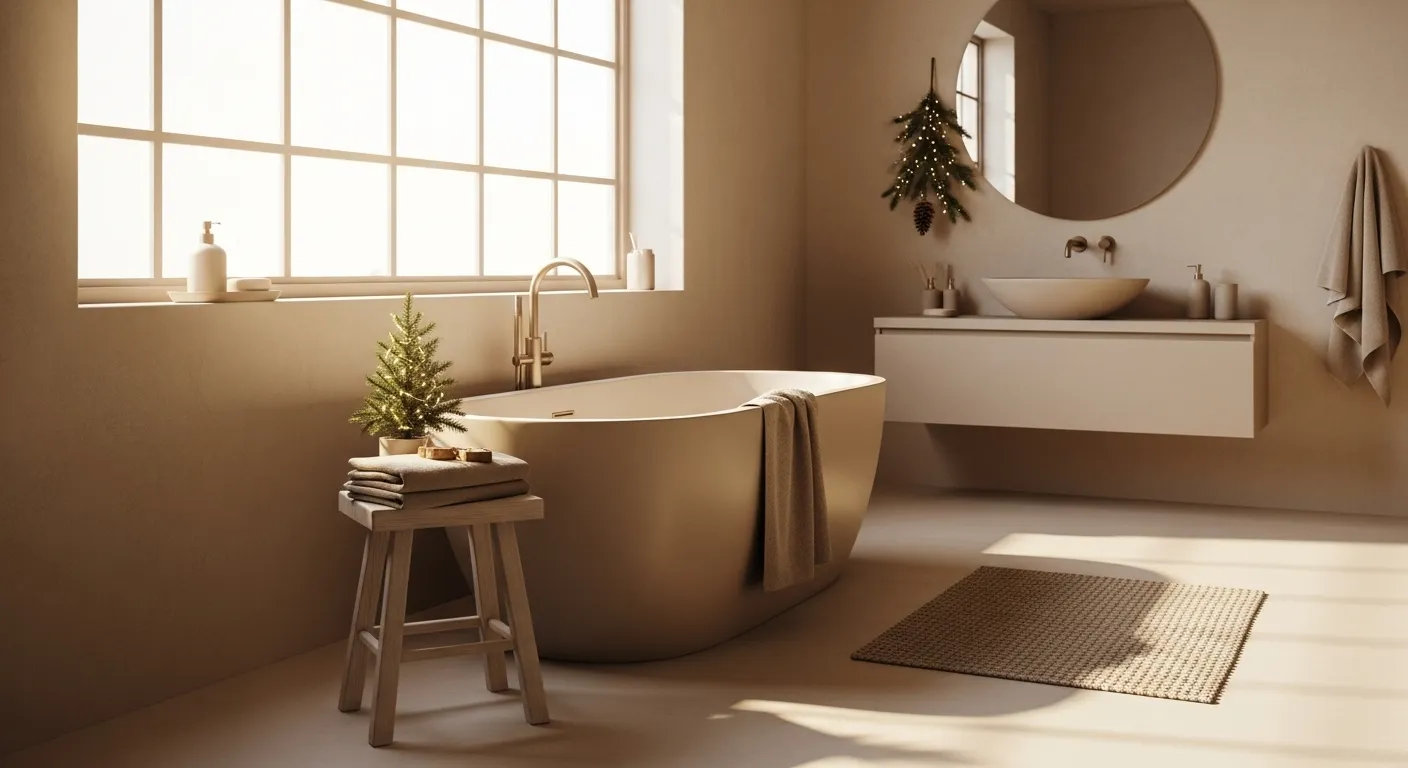
The image below is a great “mid-to-high” reference: the room reads airy and minimal, but the shapes (tub, mirror, vanity) and finishes do the heavy lifting—exactly what Japandi decor is about.
Where to Shop
Vanities, mirrors, and storage
- Home improvement retailers: good for vanities, faucets, mirrors, and basic lighting at entry and mid budgets.
- Kitchen & bath showrooms: best for higher-end fixtures, stone tops, and getting finish samples in person.
- Online cabinet makers: helpful if you want a floating wood vanity look with more sizing options.
Tile, stone, and “quiet” surfaces
- Tile warehouses: better pricing and more neutral porcelain options for a Beige Bathroom base.
- Local stone yards: great for seeing warm-beige quartz or subtle natural stone without surprises.
- Specialty plaster/microcement suppliers: for that seamless spa finish (plan for pro install).
Japandi decor + Christmas finishing touches
- Minimal home goods categories: look for stone trays, ceramic vessels, matte soap pumps, lidded jars.
- Textile sections: waffle towels, linen shower curtains, bath mats in oatmeal/ivory tones.
- Floral/greenery markets: eucalyptus, cedar, pine stems—keep it natural and simple.
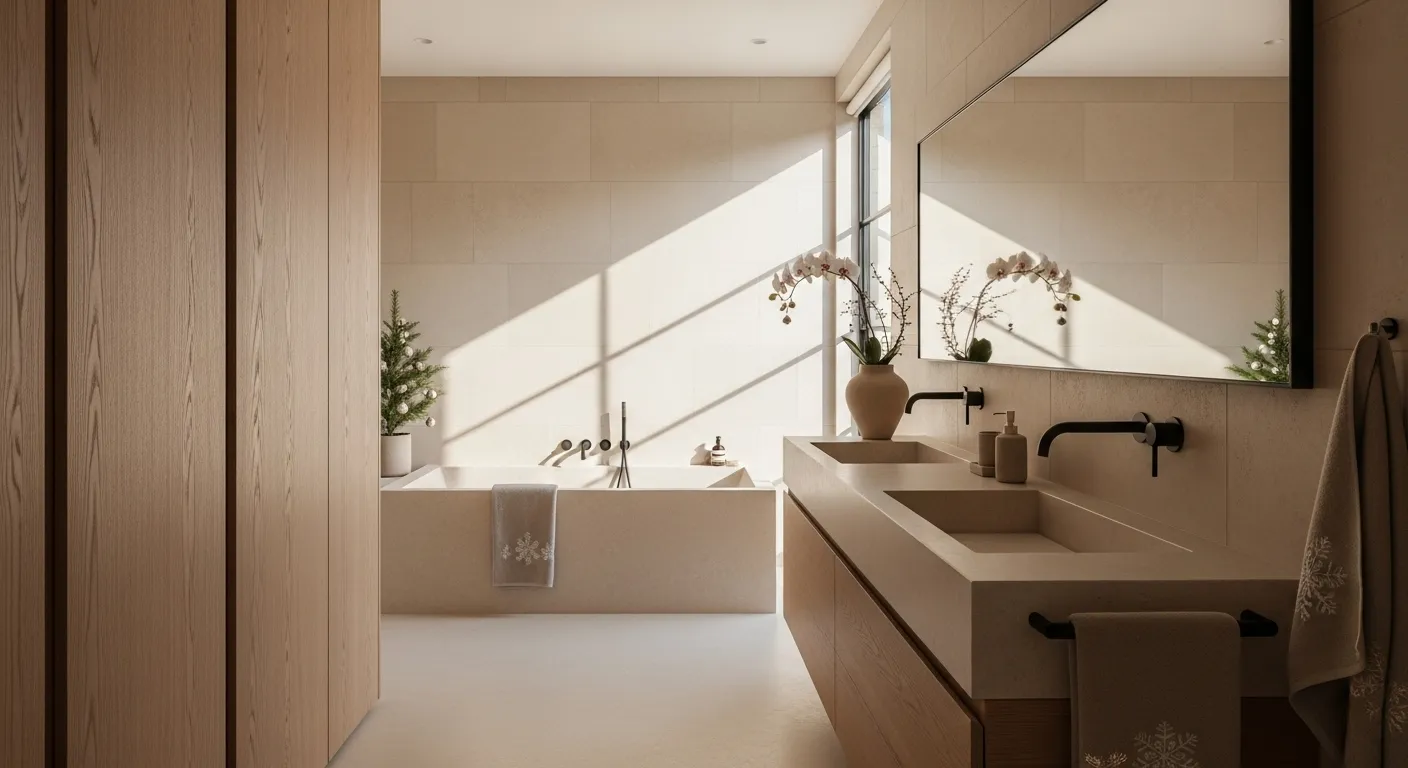
If you’re furnishing a shared bath, use the visual below as a checklist: double vanity for function, calm beige tones, and a tub that feels sculptural—not bulky. This is the kind of reference I keep open when I’m sourcing, so I don’t drift into overly ornate pieces.
FAQ
1) Can a Beige Bathroom still look modern?
Yes—modern beige is all about matte finishes, clean lines, and contrast. Add a slim-framed mirror, a matte black faucet, and keep decor minimal so the beige reads intentional, not dated.
2) What’s the easiest way to add Japandi decor without renovating?
Swap textiles (waffle towels, linen-look shower curtain), unify countertop items (matching pumps/canisters), and add warm lighting on a dimmer. Those three steps usually create the “Japandi” feeling immediately.
3) How do I keep beige from feeling flat?
Texture. Layer at least four textures: matte tile, wood grain, a soft textile, and a small stone/ceramic accessory. Also include one contrast tone (black/charcoal/dark bronze) to outline the shapes.
4) What Christmas decor works best in a Japandi bathroom?
One greenery moment (eucalyptus or cedar), one warm scent (hinoki/pine candle), and one sculptural object. Keep it natural and edited so the room stays serene.
5) Are freestanding tubs necessary for Japandi Bathroom ideas?
No. They photograph beautifully, but Japandi is more about proportion, calm materials, and minimal styling. You can get the look with a standard tub by updating the surround tile, lighting, and vanity.
6) What’s a simple way to style open shelving?
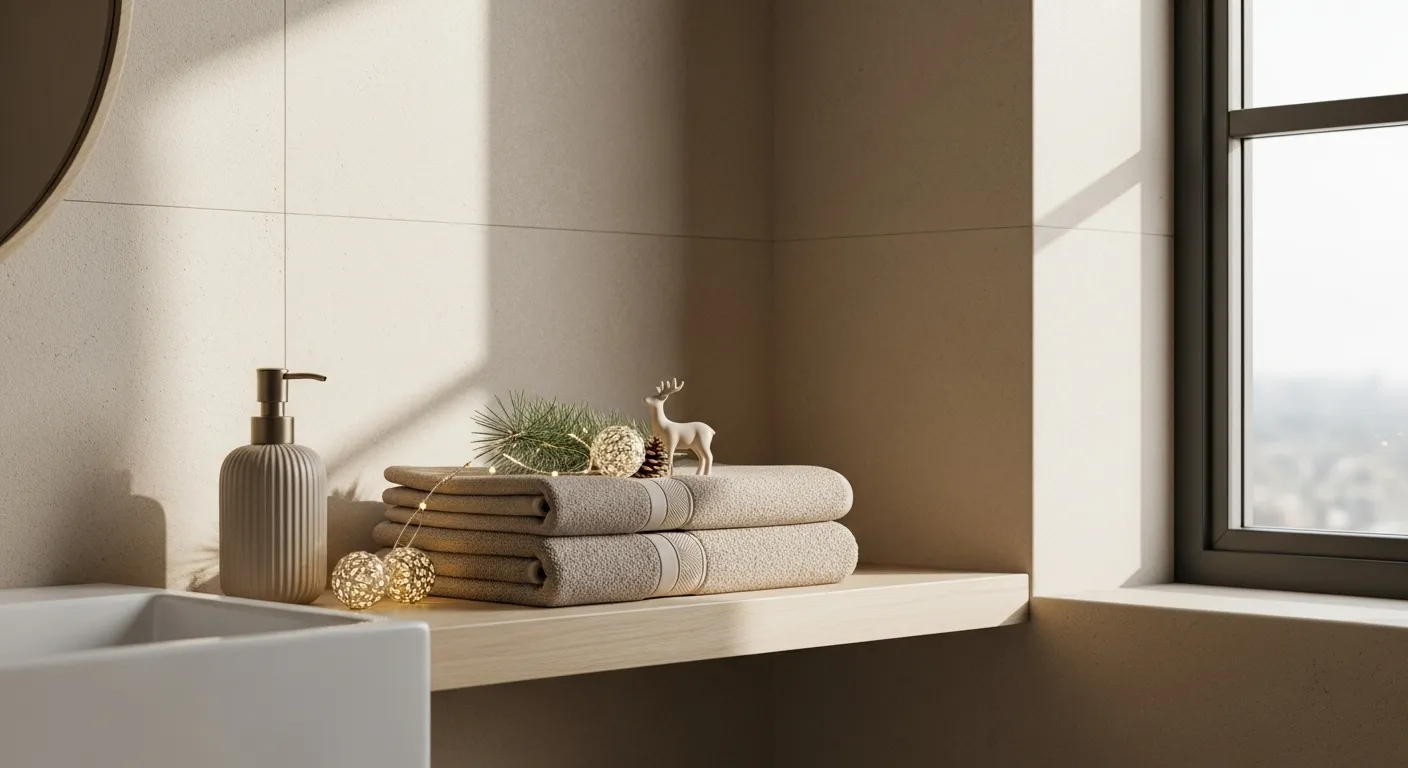
Use the “stack and one” method: two folded towels + one functional object (soap) + one vessel (small vase). Leave negative space. The shelf vignette below shows how sunlight, beige tile, and a few essentials can feel complete without clutter.
Final Thoughts
The best Japandi Bathroom ideas don’t rely on a single “statement” purchase—they rely on restraint, warm neutrals, and tactile materials that make daily routines feel calmer. Start with your beige base, add one consistent wood tone, define the lines with subtle contrast, and then style for Christmas with just a hint of evergreen and warm light. If you keep editing as you add, your Beige Bathroom will feel like a spa all winter—and the Japandi decor will still feel timeless once the holidays are over.